

Have a news story for Floorscape? Get in touch with us to submit editor@floorscape.org.uk
Have a news story for Floorscape? Get in touch with us to submit editor@floorscape.org.uk
Keeping a floor clean is vitally important, not just because of hygiene, which is of course essential, but a well cleaned floor will last longer, retain its appearance and optimise safety aspects. Conversely a poorly maintained floorcovering can lose its visual aesthetic, become less safe in relation to slip-resistance and wear prematurely, thereby reducing the return on the investment.
Whilst maintenance is not the only factor that influences the performance of a floor in use (floorcoverings can become slippery due to contamination), both cleaning (regular removal of soiling) and maintenance (less frequent planned activity) are vitally important in ensuring that a floor covering remains safe and retains optimum aesthetics and performance. It is sometimes argued that poorly maintained floor coverings are no longer fit for purpose in use.
This is why it is so important that there is a common understanding of correct and recommended floor cleaning and maintenance across all the parties that are involved in the flooring design, specification, installation and care in use.
CFA members are regularly asked to comment on poorly or incorrectly maintained floors where there is nothing wrong with the product or installation, yet the client believes it to be defective. This is costly in time to manage the query or complaint and potentially damaging to long-term relationships and repeat orders.
Unrealistic customer expectation or understanding in relation to maintenance can be an issue. All floor coverings need cleaning and maintaining, yet it is not uncommon for a client to express surprise if a floor becomes soiled even if it is never cleaned. Various practical assessments have shown that over 75% of soiling within a building comes from the outside, and yet buildings often have inadequate entrance flooring systems (barrier matting) or maintenance regimes for them specifically in place.
The type of traffic and nature of use of the building are all important. A small office, when compared to a call centre or an office next to an engineering works, all have very different demands. Will the building be in use 24/7 (e.g. a hospital, supermarket or service station)? The type and level of soiling for many of these locations adds additional demands to the specification and maintenance required including the entrance system or matting.
Lighter colours may be better for energy consumption (lighting) and LRV (light reflection values) but will show soiling more readily and may therefore require more frequent cleaning.
Has the building got cleaning stations with access to water, cleaning sinks and adequate storage for equipment and cleaning solutions? Is power available in the relevant areas?
Insufficient entrance matting is a common problem. All floor coverings with an external entrance need an entrance flooring system that British Standard BS 7953 suggests should maximise the space available wherever possible to ensure soiling is removed from user traffic. Six steps is commonly offered as a guide but may not be practical in some spaces and equally higher traffic flow may require significantly more. They come in various forms with different characteristics for removing different types of soiling. Throw-down mats are generally accepted as the least effective and can present a trip hazard and should only be a temporary option. A fully designed and fitted entrance flooring system solution should be specified with the floor covering.
Ideally, floors should be one of the last items in a building to be completed. In those circumstances, where other trades are highly likely to traffic, it is vital that suitable protective covering material is used. Specific specialist products are available. Failure to protect floors prior to handover often results in permanent damage.
Prior to the floor receiving regular cleaning, it is very likely to require an initial clean to remove builders’ contamination and soiling. It is vital that the floor covering manufacturers’ guidelines are followed at all stages.
The wrong regime and/or the wrong products used at this stage can be catastrophic going forward. If the new floor covering is not cleaned properly in this very first instance, it can make subsequent cleaning and maintenance virtually impossible.
Ensure the cleaning contractor is fully informed of the products installed and the cleaning requirements for each flooring type. Cleaning operatives should be fully trained in the use of cleaning products and equipment that they are going to use. RAMS (risk assessments and method statements) need to be issued and always be available. Make sure the cleaning contractor and their operatives have been fully trained about the floorcovering type, products and equipment they are going to use. It is imperative this is in accordance with manufacturers’ recommendations.
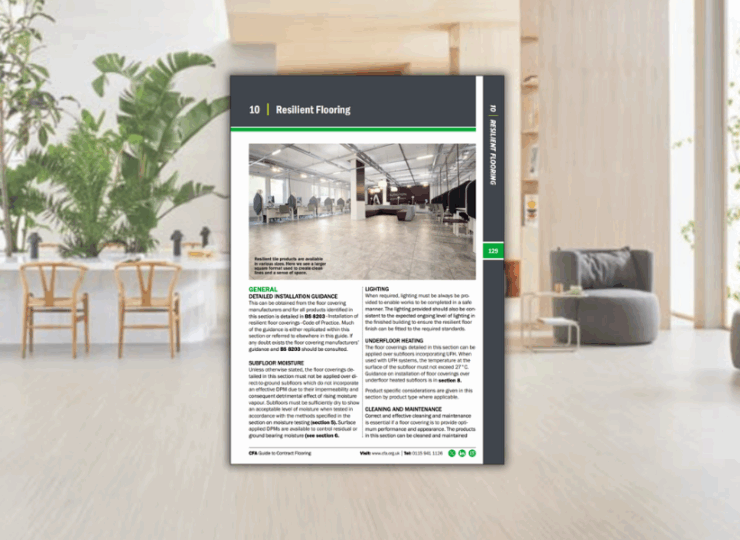
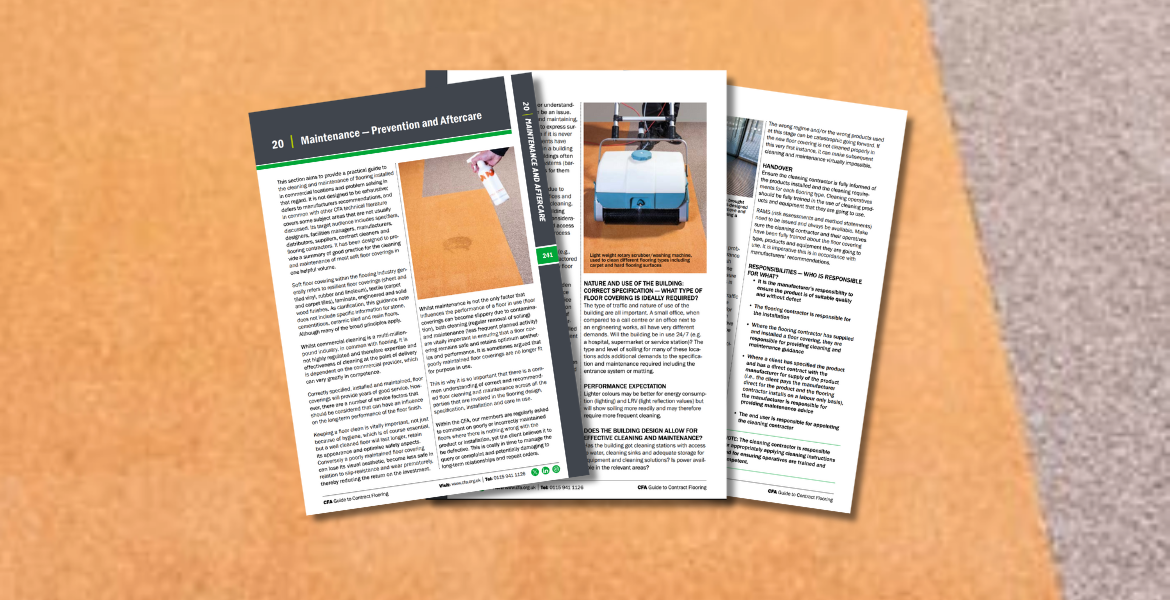
For more technical advice visit the CFA Guide to Contract Flooring.




Floorscape aims to serve as a valuable resource for both
the contract flooring
industry and
associated parties including architects, designers, main
contractors, shopfitters, builders
and
clients and is fully supported by the Contract Flooring Association.