

Have a news story for Floorscape? Get in touch with us to submit editor@floorscape.org.uk
Have a news story for Floorscape? Get in touch with us to submit editor@floorscape.org.uk
The term ‘circular economy’ is increasingly used across most industries, from fashion to flooring. At its simplest, the circular economy is a shift away from the traditional ‘take-make-waste’ model. Instead of extracting raw materials, turning them into products and discarding them at the end of their life, a circular approach keeps materials in use for as long as possible. That means designing products to be reused, repaired or recycled, and treating them as valuable resources rather than disposable items.
The UK Green Building Council (UKGBC) describes the circular economy as an approach that prioritises reuse and reduces the amount of valuable material sent to landfill. Circular economy charity, The Ellen MacArthur Foundation, puts it even more bluntly – design out waste, keep materials circulating at their highest value, and regenerate nature rather than deplete it.
For the flooring industry, these ideas are not abstract. For example, it’s estimated that more than 400,000 tonnes of flooring waste – such as carpets, rugs and mats – are generated each year in the UK. Resilient flooring waste such as vinyl, luxury vinyl tiles (LVT) and linoleum will add significantly to this tonnage. Reducing waste is essential if the sector is to cut its environmental impact and support the UK’s net-zero ambitions.
In a circular economy, flooring products are designed to be lifted, reused, repaired or recycled into new materials at the end of their first service life. Some manufacturers have already redesigned traditional products to use a single polymer throughout, or ones that can be more easily separated into component parts to facilitate recycling. Some also offer their own take-back schemes. These schemes allow certain flooring products to be returned after uplift, where they can be either reused directly or reprocessed into new products.
While natural materials such as wood and stone are more easily suited to circular models – as they are single-material products that can be reused directly or broken down for reuse – textile and resilient flooring products present a particular challenge.
These types of flooring are often complex composites, designed to be durable and long-lasting, with multiple layers bonded together. While this improves performance, it can make separation difficult and recycling more challenging.
Installation methods also play a role. Traditional adhesive-based installations can damage products during uplift, limiting opportunities for reuse. In response, some manufacturers are exploring alternative installation techniques that allow easier removal with minimal damage, while others are redesigning products to improve material separation and increase recycled content.
Smarter design is key. By considering the full life cycle of a product – from raw material extraction through to end-of-life recovery – the industry can significantly improve circular outcomes.
Like many sustainability movements, the circular economy comes with its own terminology. Fortunately, most of it is more straightforward than it sounds:
Alongside industry-led innovation, the Government is also accelerating the shift. Through the Circular Economy Taskforce established by the Department for Environment, Food and Rural Affairs (DEFRA), the UK Government is encouraging businesses to keep resources in circulation, cut emissions and create green jobs by adopting more circular business models.
For a sector like flooring, where large volumes of material are manufactured, installed and removed each year, this shift presents both environmental and economic opportunities. Reducing waste lowers disposal costs, while durable, modular and reusable products can deliver long-term savings for customers and manufacturers alike.
Importantly, the circular economy is not a future aspiration. It is already reshaping how flooring products are designed, specified, installed and recovered across the built environment. It challenges us to think differently about materials – not as single-use items, but as assets that should deliver value again and again.
By adopting reuse models, selecting low-impact materials, designing for longevity, implementing take-back schemes and engaging with national policy, flooring specifiers, contractors and manufacturers can all play a role in accelerating the UK’s transition to a low-carbon, resource-efficient future.
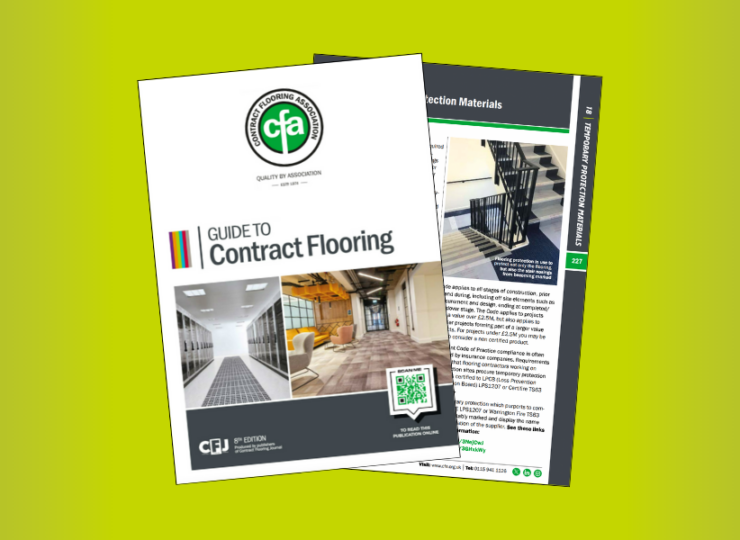
For more information about flooring sustainability and the circular economy, read the CFA Guide to Sustainability 2025–2026 or the CFA guidance document ‘Zero Avoidable Waste in Flooring – A Scoping Study (2021)’.



Floorscape aims to serve as a valuable resource for both
the contract flooring
industry and
associated parties including architects, designers, main
contractors, shopfitters, builders
and
clients and is fully supported by the Contract Flooring Association.