

Have a news story for Floorscape? Get in touch with us to submit editor@floorscape.org.uk
Have a news story for Floorscape? Get in touch with us to submit editor@floorscape.org.uk

The flooring industry, with its unique challenges and opportunities, is perfectly poised to lead the way through collective action. Collaboration in this sector is not just about sharing best practices but involves creating systems and frameworks that address sustainability holistically – from production to installation, and eventually, to disposal.
Below, we explore some critical areas where industry collaboration could transform sustainability efforts in the flooring industry.
Transparency is particularly critical in demonstrating compliance with green building standards like LEED or BREEAM. Publishing verified environmental data, such as Environmental Product Declarations (EPDs) fosters trust between manufacturers, customers, and regulatory bodies. EPDs provide manufacturers with insights into their products’ environmental hotspots, enabling targeted efforts to reduce emissions, waste, or resource consumption.
For example, an EPD might reveal that a flooring adhesive has a significant carbon footprint due to its chemical formulation, prompting innovation toward bio-based alternatives.
EPDs also include data on recyclability and end-of-life disposal options, helping to identify products that align with circular economy principles.
They ensure that stakeholders in the flooring industry can prioritise materials and products designed for reuse or recycling, reducing waste and conserving resources.
With EPDs, consumers and specifiers can make choices based on verified environmental performance, creating demand for more sustainable products.
For example, flooring contractors might select adhesives with EPDs indicating low VOC emissions and high recyclability to align with client sustainability goals.
By providing critical, standardised insights into a product’s environmental impact, EPDs empower the flooring industry to make data-driven decisions, foster innovation, and accelerate the transition toward sustainability.
Packaging plays a critical role in the flooring industry, not just for protecting products during transportation but also in determining the overall environmental footprint. Over the past decade, the industry has made strides to innovate and reduce packaging waste, aligning with sustainability goals.
Adhesive buckets are now often made with PCR plastics, reducing reliance on virgin materials, while many smoothing compounds are being introduced as one-part products in favour of ‘bag and bottle’.
The striving towards sustainability goes beyond packaging, with companies also developing low-carbon adhesives and smoothing compounds that reduce environmental impact while maintaining performance. These products use alternative binders, bio-based polymers, and lightweight formulations to minimise carbon emissions during production and installation.
Adhesives are designed to form strong bonds between floorcoverings and subfloors, making it difficult to separate these layers at the end of a product’s lifecycle. Traditional adhesives often leave residues on both surfaces, contaminating the flooring material and rendering it unsuitable for recycling.
Removing adhesive contamination requires additional processing steps, such as mechanical scraping, chemical treatment, or thermal cleaning. This can increase the cost and energy use of recycling and limits the economic viability of recycling flooring materials on a large scale.
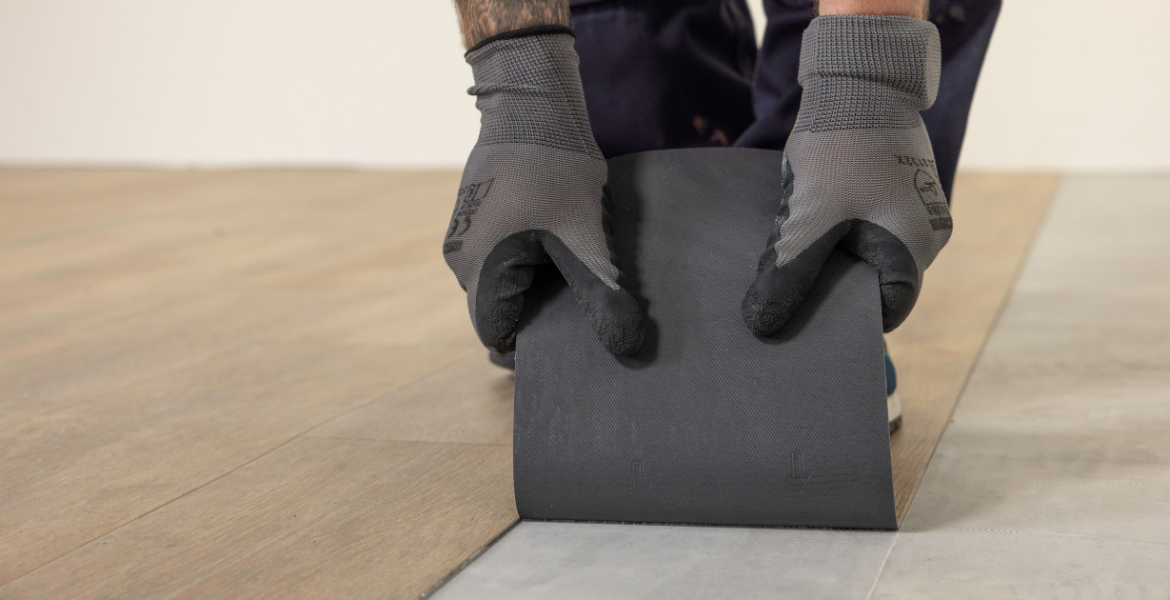
‘Reversible’ adhesives aim to be a promising solution, allowing for easier removal of floorcoverings at the end of life without damaging the materials. They promote easy installation and removal of floorcoverings such as vinyl and LVT flooring with no residue, even years later, allowing the flooring to be recycled at the end of its life. Once removed, the goal is that reversible adhesives leave behind a subfloor that requires next to no preparation, meaning renovation times and carbon footprint is significantly reduced.
Sustainability in flooring is a challenge that no single company can tackle alone. The industry has a long history of developing installation standards through collaborative efforts. There’s no reason why this existing model can’t be extended to sustainability by incorporating guidelines for sustainable installation practices, backed-up by training programmes to educate installers about the importance of proper product selection and material handling.
By aligning goals, pooling resources, and embracing innovation, stakeholders across resources and the supply chain can ensure that flooring not only improves the aesthetic appeal of spaces, but also supports a healthier, more sustainable world.
For more information on the sustainability of adhesives and accessories visit the CFA Guide to Sustainability 2025–2026.



Floorscape aims to serve as a valuable resource for both
the contract flooring
industry and
associated parties including architects, designers, main
contractors, shopfitters, builders
and
clients and is fully supported by the Contract Flooring Association.