

Have a news story for Floorscape? Get in touch with us to submit editor@floorscape.org.uk
Have a news story for Floorscape? Get in touch with us to submit editor@floorscape.org.uk
The Contract Flooring Association (CFA) is periodically approached to comment on the use of safety knives with retractable blades for the installation of floor coverings. This is often from an initiative driven by the client or main contractor to improve site safety. As such it is important to immediately stress that the CFA wholeheartedly support all initiatives that add to safety on site. However, it is of course important that these initiatives are appropriate and achieve that end.
For commercial and professional applications, a fixed blade knife is generally accepted as the best piece of equipment, where the blade is securely held in position by the handle of the knife. Blades are changed by unscrewing the body of the knife to release them. As a very general statement, knives with retractable blades would usually be classed as hobby, craft or DIY products. If ever used in a ‘professional’ setting, they are generally only employed in warehousing or similar situations for removing packaging. This is also generally felt to be the limitation of their safe use.
As previously mentioned, the flooring industry and specifically fitters generally prefer to use a fixed blade knife. As many of the materials that are frequently installed require quite a lot of force to cut them, the fixed blade type of knife is used because it allows the control and pressure required and is also ergonomically designed to fit in to the installer’s hand. It is felt by many that knives with retractable blades and without this ergonomic design are in fact more likely to lead to injury if used for a flooring application.
As a general comment, experience has shown that the retracting mechanisms can be unpredictable when used with the type of pressure required to cut flooring materials. Of course, the professional products also have a ‘holster’ and good practice would always suggest that the knife should be returned to the holster when not in use.
This leads to the subject of training. This is of course where CFA flooring contractors excel with the support they have available. It is important that all operatives using any sort of equipment are trained and can demonstrate that they have received training in order to carry out the work they are employed for.
Alongside experience, evidence could include CSCS cards (which includes a H&S test and an NVQ level 2), the FITA QA card, as well as attendance of FITA training courses. On site, health and safety would also be underpinned by a method statement, risk assessment appropriate contract supervision.
In summary, the CFA would not generally recommend the use of ‘safety knives’ for flooring applications and would again stress that in our opinion they can add to hazard if used for a flooring application.
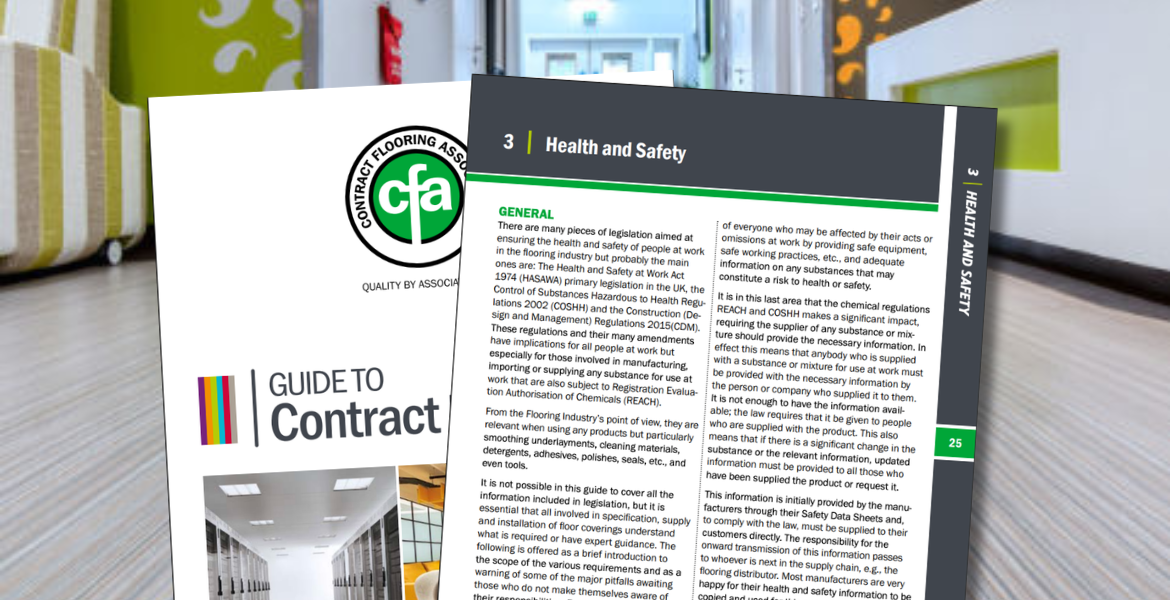
For more information about health and safety, download and read the CFA Guide to Contract Flooring.
As a CFA member, contractors are able to access the CFA’s health and safety benefit helpline to ensure they remain up to date and fully compliant. Member benefits are available from the CFA Members’ Area. Further information about the benefits of joining are available online.
To specify a CFA contractor member, visit the CFA directory.


Floorscape aims to serve as a valuable resource for both
the contract flooring
industry and
associated parties including architects, designers, main
contractors, shopfitters, builders
and
clients and is fully supported by the Contract Flooring Association.