

Have a news story for Floorscape? Get in touch with us to submit editor@floorscape.org.uk
Have a news story for Floorscape? Get in touch with us to submit editor@floorscape.org.uk
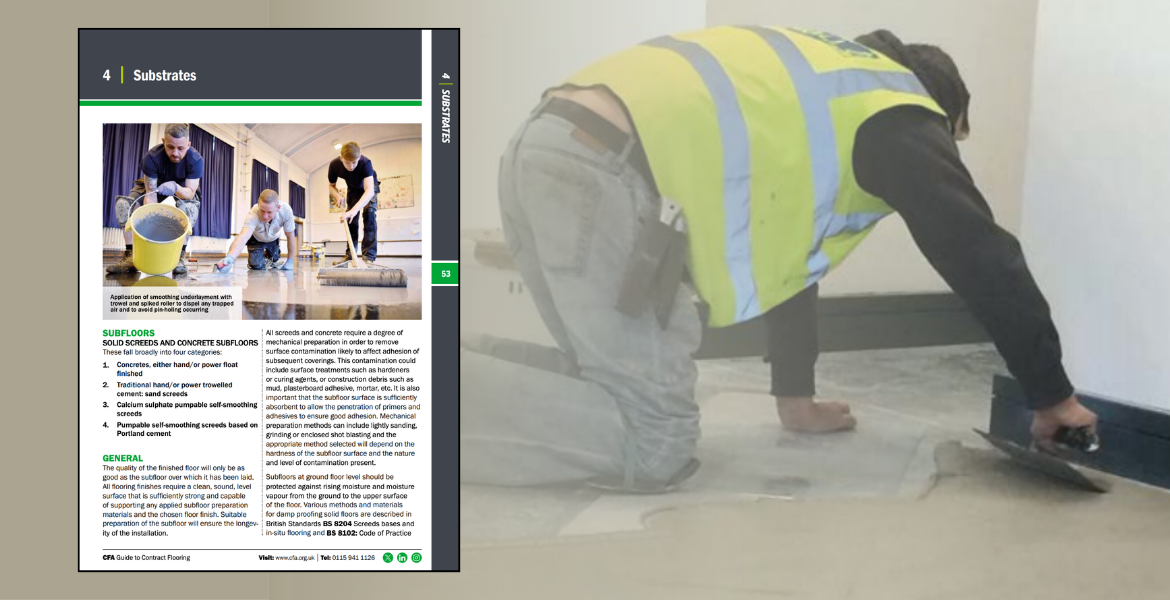
The quality of the finished floor will only be as good as the subfloor over which it has been laid. All flooring finishes require a clean, sound, level surface that is sufficiently strong and capable of supporting any applied subfloor preparation materials and the chosen floor finish.
Solid screeds and concrete subfloors fall broadly into four categories:
This article focuses on the mechanical preparation and key information required for working with concrete and cement:sand screeds.
Concrete base slabs which are to receive floor coverings or levelling screeds direct to their surface should typically offer a minimum compressive strength of C25/30. BS 8204: parts 1–7 gives guidance on the installation of concrete bases to receive resilient, wood and textile floor coverings, in-situ floorings such as synthetic resin floorings, in-situ terrazzo, etc. Some may require a concrete base slab having a characteristic concrete strength class of C28/35.
The power trowelling of a concrete floor slab has a large influence on the choice of adhesive used for fixing floor coverings. Care needs to be exercised in ensuring that the flooring material and the concrete surface will give adequate absorption and allow the dissipation of any free water or solvent vapours thus enabling sufficient adhesion to both surfaces. The final finish of the power floated surface will also influence adhesion, a mirror finish may look good but it may prove difficult to achieve an adequate bond of a waterproof surface membrane, adhesive or floor smoothing underlayment to the surface. The dense surface finish will also considerably extend the drying time of the concrete slab.
NOTE: Externally applied curing agents should be removed seven days after installation from the surface of the concrete base slabs to allow unrestricted drying of the concrete.
These screeds have been employed for many years in the UK and continue to be widely used.
Cement:sand screeds are generally manufactured using a mixture of Portland cement, blended bagged cements, general purpose sharp sands or concrete sands, water and special additives where required. They can be manufactured by some ready-mix screed suppliers but are commonly hand mixed on site. They are usually hand placed and compacted and then hand trowelled, although for larger areas power trowels and pumps can be used. They can be employed where screeds to falls are required.
Cement:sand levelling screeds can be bonded to a concrete base providing the base has been suitably prepared, thickness nominally 40mm, minimum 25mm.
Cement:sand or fine concrete levelling screeds can be laid unbonded normally over a separating layer and should not be less than 50mm thick. BS 8204 considers that a screed laid directly to an unprepared sub-base to be unbonded. They should be reinforced using either steel mesh reinforcement or polypropylene fibres.
These are laid over separating membranes on thermal or acoustic insulation and should be not less than 75mm thick, or 65mm in domestic situations. Some proprietary screeds may be laid in thinner sections. Seek manufacturers’ advice.
Cement:sand screeds should be cured for a minimum of 7 days following installation by covering with polythene. It is less common to see spray on curing membranes used although these are available. The screed should be placed into a weather tight environment and not be subjected to severe draughts, direct sunlight or heating for the first 72 hours. Foot traffic should be restricted for at least 7 days to prevent damage to the screed surface. They should generally not be loaded for a minimum of 28 days.
Drying times will vary according to the product used and manufacturers’ guidance should be sought on appropriate drying times. Poor site condition and deeper screed sections will extend drying times so it important to ensure that site conditions are well controlled.
Cement:sand screeds should not be force dried and commissioning of any UFH should be avoided for a minimum of 21 days.
Before floor finishes are laid, the moisture content of the screed should be checked. The British Standard for testing a base to receive a floor covering is to use a surface or probe hygrometer. This provides a non-destructive test and, when tested strictly to the method defined, will give reliable results on calcium sulphate screeds for RH up to 75% (the required limit for floor finishes).
The installation code of practice for some product groups also accepts the hygrometer sleeve method. If this method is being considered it is important to check the code of practice that applies to the product type being installed.
Cement:sand screeds, once fully dried, are generally very absorbent. Therefore, the screed must be primed with a suitable primer to prevent premature drying of smoothing underlayments.
NOTE: Where moisture levels exceed 75%RH (65%RH for some timber flooring installations) consult manufacturers to ascertain if there is an option for a surface DPM or application to be made. Where surface DPMs are not suitable then the subfloor must be allowed to further dry. Drying can be encouraged by providing good airflow, dehumidification and ambient temperature conditions. Use of any underfloor heating, where present, may also be considered. Specifiers need to be aware manufacturers differ in regard to their recommendations, and it is essential that clear directions are given to installers.
For more advice about substrates and subfloors, visit the CFA Guide to Contract Flooring.




Floorscape aims to serve as a valuable resource for both
the contract flooring
industry and
associated parties including architects, designers, main
contractors, shopfitters, builders
and
clients and is fully supported by the Contract Flooring Association.