

Have a news story for Floorscape? Get in touch with us to submit editor@floorscape.org.uk
Have a news story for Floorscape? Get in touch with us to submit editor@floorscape.org.uk
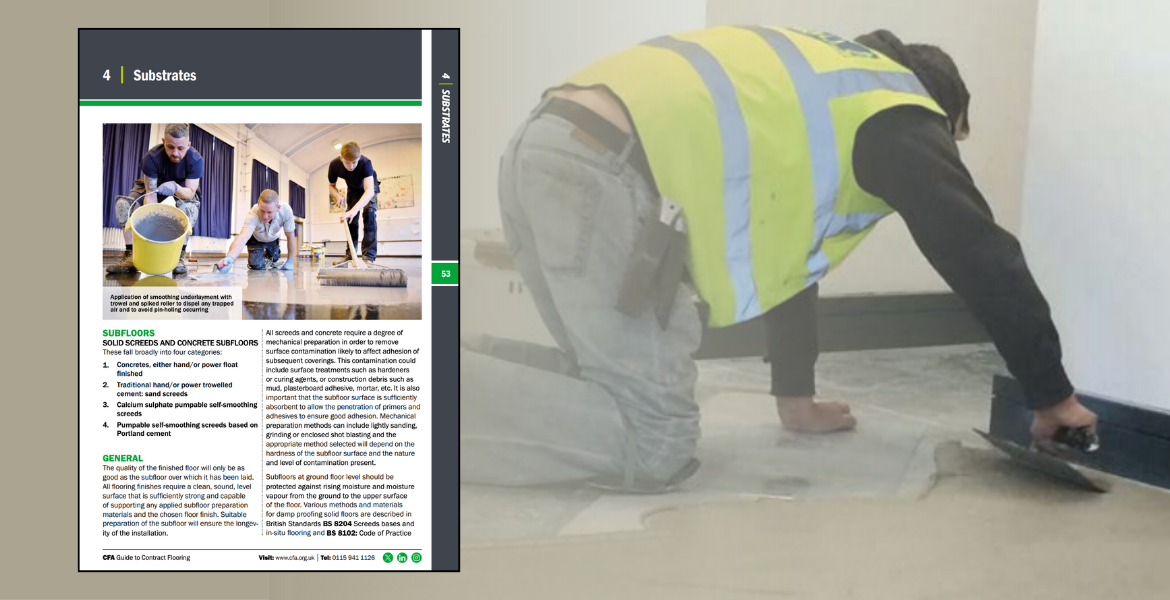
The quality of the finished floor will only be as good as the subfloor over which it has been laid. All flooring finishes require a clean, sound, level surface that is sufficiently strong and capable of supporting any applied subfloor preparation materials and the chosen floor finish.
Solid screeds and concrete subfloors fall broadly into four categories:
This article focuses on the mechanical preparation and key information required for working with calcium sulphate subfloors.
Calcium sulphate subfloors are alternatives to sand and cement levelling screeds based on calcium sulphate instead of Portland cement. They are usually supplied with the calcium sulphate being either based on anhydrite or on alpha hemihydrate. The calcium sulphate binders are usually manufactured to BS 13454 using by-products of other processes such as flue gas desulphurisation or acid production. These binders are mixed with sand, water and additives where appropriate to BS 13813.
The finished screed mortars may be supplied ready-mixed in agitator trucks or mixers, mixed on site by volumetric mixers, or can be mixed from pre-blended bagged ingredients. They are generally pump applied.
Calcium sulphate levelling screeds can be bonded to concrete bases providing the base has been suitably prepared, with a thickness minimum of 12mm.
Calcium sulphate levelling screeds can be laid unbonded, normally over a separating layer, typically not less than 30mm. For thinner sections manufacturer’s guidance should be sought.
Floating levelling screeds are laid over separating membranes on thermal or acoustic insulation boards or quilts and should typically be no less than 40mm thick or 35mm in domestic situations. For thinner depths manufacturer’s guidance should be sought.
Some manufacturers offer proprietary screed mix designs which can be thinner.
Calcium sulphate-based screeds are self-curing and need no external curing agents or membranes. The screed should be placed into a weather tight environment and not be subjected to severe draughts, direct sunlight or heating for the first 72 hours. Foot traffic should be restricted for at least 24 (preferably 48) hours to prevent damage to the screed surface.
Several types of calcium sulphate screed are currently available. Some produce a friable flaky laitance on the surface where others do not. Friable laitance will usually be sanded off the screed at an early stage, whilst non-friable laitance will usually be prepared during the process of mechanical abrasion carried out on all screeds to provide a surface key and remove surface contamination.
Typically, calcium sulphate screeds can be loaded after seven days following installation.
Drying times will vary according to the product used and manufacturer’s guidance should always be sought on the appropriate drying times. Drying times are usually based on 40mm to 50mm depth in warm and well-ventilated drying conditions, typically <65%RH at 20ºC. Poor site condition and deeper screed sections will extend drying times so it is very important to ensure site conditions are well controlled.
Good ventilation or the use of dehumidifiers can assist in reducing the ambient humidity. Forced drying of these screeds is possible if required. After 3 days dehumidifiers may be employed, and after 7 days the underfloor heating (UFH) may be commissioned and slowly brought up to temperature to force dry the screed reducing drying times significantly.
Before floor finishes are laid, the moisture content of the screed should be checked. The British Standard for testing a base to receive a floor covering is to use a surface or probe hygrometer. This provides a non-destructive test and when tested strictly to the method defined will give reliable results on calcium sulphate screeds for RH up to 75% (the required limit for floor finishes).
The installation code of practice for some product groups also accepts the hygrometer sleeve method. If this method is being considered it is important to check the code of practice that applies to the product type being installed.
The moisture content of calcium sulphate screeds is sometimes checked using the CM Test/oven drying method (BS 8204 Part 7). This method is a destructive test and if used the moisture content should be less than 0.5% at 75% RH.
In the presence of excess moisture, cementbased smoothing compounds and calcium sulphate can react to form Ettringite, which is an expansive crystal that damages the bond between the smoothing compounds and calcium sulphate screeds which may result in subsequent failure of the floor covering installation.
Therefore, the screed must be primed with a suitable primer as recommended by the manufacturer of the product. An alternative method of mitigating the risk of Ettringite failure is to use a calcium sulphate-based smoothing compound.
For more advice about substrates and subfloors, visit the CFA Guide to Contract Flooring.




Floorscape aims to serve as a valuable resource for both
the contract flooring
industry and
associated parties including architects, designers, main
contractors, shopfitters, builders
and
clients and is fully supported by the Contract Flooring Association.