

Have a news story for Floorscape? Get in touch with us to submit editor@floorscape.org.uk
Have a news story for Floorscape? Get in touch with us to submit editor@floorscape.org.uk
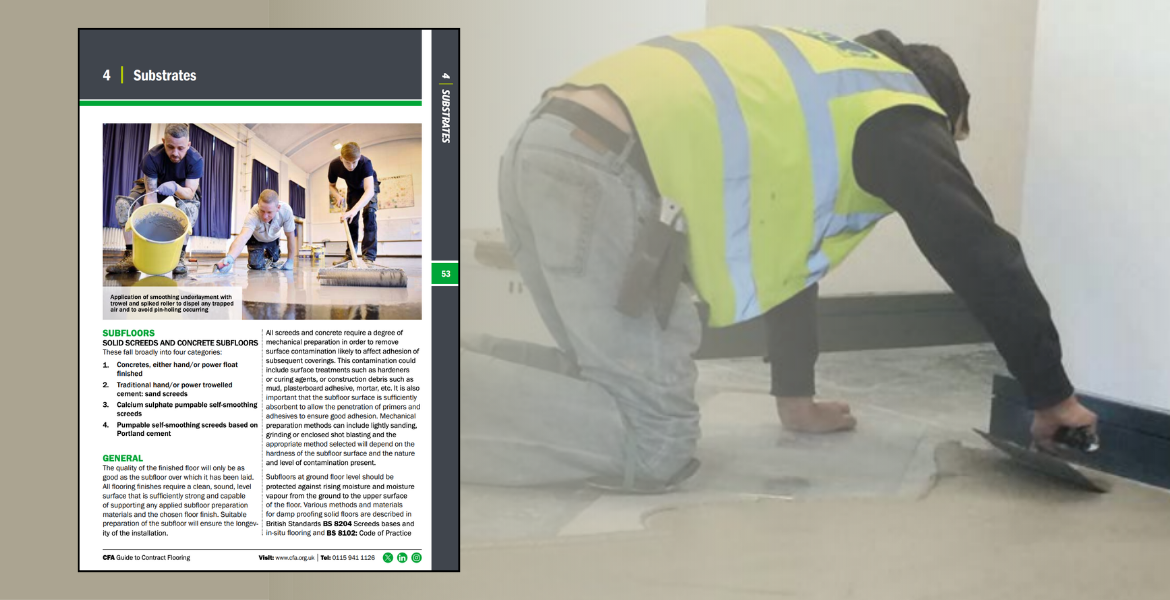
The quality of a finished floor will only be as good as the subfloor over which it has been laid. All flooring finishes require a clean, sound, level surface that is sufficiently strong and capable of supporting any applied subfloor preparation materials and the chosen floor finish.
This article focuses on general considerations and responsibilities for main contractors and flooring contractors in regard to any screed installation on site.
All traffic, including pedestrians, should be kept off the screed until it has hardened sufficiently in accordance with the manufacturer’s recommendations. The screed should be protected from contamination and damage by other trades and should be protected until the floor covering is applied.
See BS 5325, 8201, 8203 and 8425 Codes for Practice for Installation of Textile Floorcoverings, Timber and Timber-based products, Resilient Floorcoverings and Laminate Floorcoverings.
To ensure the smooth installation of floor screeds and subsequent floor coverings it is advisable that all parties have a clear understanding of the requirements and programming required. To ensure that this is achieved it is suggested that all parties involved in the project consult at an early stage in the contract.
The area where a screed is to be installed should be protected against ingress of rain or water leaks. Once the area has been screeded further water should be avoided as this can cause damage and can considerably extend its drying time.
One of the main reasons for floor covering installation failure is excess subfloor moisture. It is essential that all those involved in the installation understand that application of the surface finishes before drying out has been completed may lead to failure unless suitable moisture mitigation/surface DPM systems are utilised.
Avoid water ingress to completed screeds. If ingress occurs consult the manufacturer/installer of the screed to check its integrity.
Where moisture levels exceed 75%RH (65%RH for some timber flooring installations) consult manufacturers to ascertain if there is an option for a surface DPM application to be made. Where surface DPMs are not suitable, then the subfloor must be allowed to further dry. This can be done effectively utilising UFH where present along with good airflow, good ambient temperature and dehumidification.
If underfloor heating (UFH) is utilised, this must have been put through a full commissioning cycle and the floor must be suitably dry or an approved surface DPM considered before installation of finishes — see section 8 of the CFA Guide to Contract Flooring for further information on UFH.
Different British Standards offer conflicting advice on commissioning procedures for UFH so manufacturer guidance is recommended.
It is the responsibility of the main contractor to ensure that surface damage/cracks, etc., are repaired prior to the floor covering installation as follows:
Fill the crack with a suitable material. The crack may require priming depending on what product is to be used to fill the crack; consult the manufacturer. Suitable crack filling materials may include low viscosity epoxy, compatible repair mortar. Should cracks not be suitable for repair then considerations may be made for decoupling/uncoupling membranes provided the finished floor coverings is suitable for use in such applications.
During surface preparation (and subsequent floor covering installation) the area should be kept clear of all trades to avoid any contamination (or damage to the floor covering).
NOTE: It is the main contractor’s responsibility to ensure that bases or screeds meet the specified standards for level, smoothness, dryness and soundness before any subsequent or finishing trades are called to commence work.
The flooring contractor retains a duty of care to the client for the correct installation of the floor finish, and if the substrate is not in a suitable condition to proceed then this should be rectified by agreement between the flooring contractor and the main contractor.
Where the contract does not have a main contractor, then the responsibility for assessing, repairing and preparing the substrate falls to the flooring contractor.
The surface of the screed should have been mechanically prepared if necessary to provide a good surface key and remove site traffic.
The surface of the screed should be dust free/vacuumed prior to the application of primers or adhesives.
The surface must be primed with a recommended primer/sealer in accordance with the product manufacturers’ instructions.
For more advice about substrates and subfloors, visit the CFA Guide to Contract Flooring.




Floorscape aims to serve as a valuable resource for both
the contract flooring
industry and
associated parties including architects, designers, main
contractors, shopfitters, builders
and
clients and is fully supported by the Contract Flooring Association.