

Have a news story for Floorscape? Get in touch with us to submit editor@floorscape.org.uk
Have a news story for Floorscape? Get in touch with us to submit editor@floorscape.org.uk
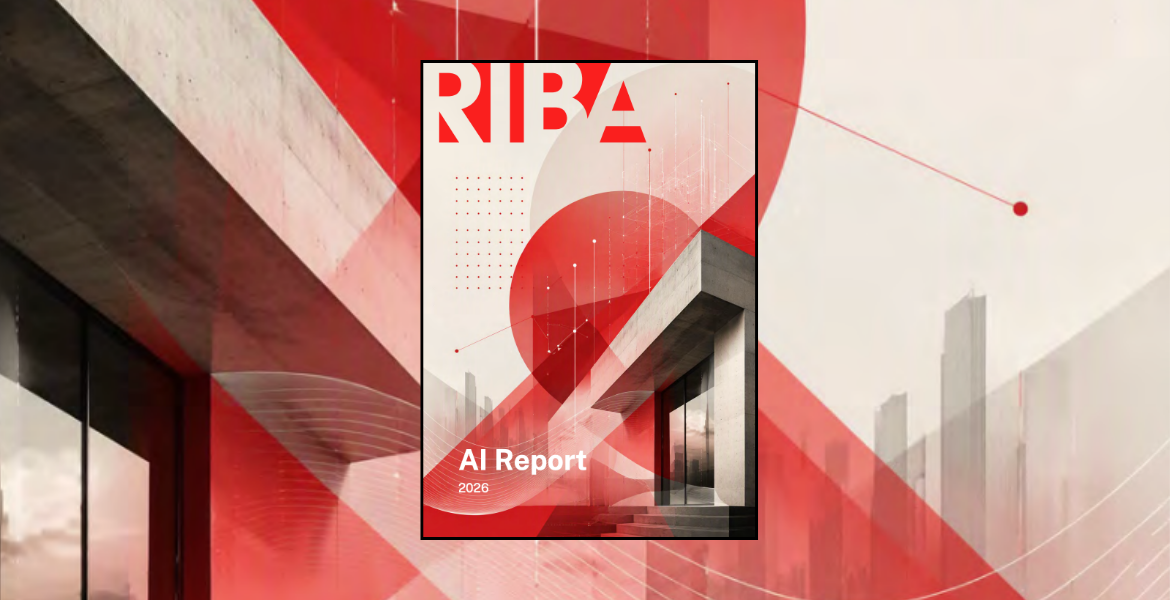
The first RIBA AI report was in 2024. In just three years, we have seen AI use expand and deepen across the profession.
Is this just a typical technology adoption curve, predictable and often seen; the ‘innovators’ finding new uses and the ‘late majority’ now joining in? Or is something more going on? Might the hype cycle be worth looking at too? Might this technology be entirely different from previous ones?
If intelligence (or something that’s a bit like it) is available at zero or low cost, what does that mean for the value of outputs (like drawings, specifications, schedules, etc.) that had previously been human-intelligence-intensive, and the preserve of the profession?
The 2026 AI report gives us some clues in three areas: firstly, the original promise of AI is being partly realised; secondly, there are important and unresolved risks with AI use; and thirdly, the profession and the process of building design will change, and, as it does, the public needs protection from unprofessional AI-generated design.
AI has become part of everyday architectural practice. Nearly three-quarters of respondents are using AI on some projects, and most expect their AI use to increase.
Respondents tell of the real benefits of AI adoption. Almost three-quarters of AI users have seen productivity improvements, and a majority say their organisation has seen a positive return on investment.
AI is increasing business profitability by improving efficiency, automating routine work, and chipping away at the often tedious administrative burden of running a business.
For now, AI use is concentrated (but not exclusively) in early-stage design visualisation, regulatory compliance checking, practice management, project management and technical design. AI is supporting architects in an increasingly complex regulatory and technical environment. It enables pre-existing tasks to be done faster and, perhaps, better, such as early-stage design iterations or visualisations for clients, for example.
By removing the routine, AI may give architects more time to focus on creativity, collaboration, client relationships and strategic thinking – the valuable work.
However, articles in the report suggest AI is set to do much more than pre-existing tasks quicker and better, something we’re already seeing in leading practices.
Across a range of articles, contributors explore how an AI-enabled profession can help re-centre architects to the heart of the commission, design, build, use process.
Through AI, architects can:
Together, these point towards a future where, enabled by AI, the role of the architect is not replaced, but expanded through augmentation. While the professions may be undergoing rapid change, the profession of the architect will remain indispensable.
Putting aside concerns of anthropomorphism, AI can be both impressive and disappointing. Approval-seeking and convincing yet thoroughly inaccurate. Gross errors. Wild hallucinations. In a sector where design decisions directly affect safety, wellbeing, sustainability and economic performance, the risks of relying on AI are very high. How long until the first catastrophic building failure because of uncritical AI use?
There are also significant issues surrounding professional indemnity insurance, liability, intellectual property rights, data security and confidentiality. These are explored in the report too, but for the most part remain unresolved, as regulation and the insurance industry work through the issues at hand. Indeed, governance in practice has not yet kept pace with adoption, with few practices having formal AI policies in place. RIBA promises to be providing guidance to help here.



Floorscape aims to serve as a valuable resource for both
the contract flooring
industry and
associated parties including architects, designers, main
contractors, shopfitters, builders
and
clients and is fully supported by the Contract Flooring Association.