

Have a news story for Floorscape? Get in touch with us to submit editor@floorscape.org.uk
Have a news story for Floorscape? Get in touch with us to submit editor@floorscape.org.uk
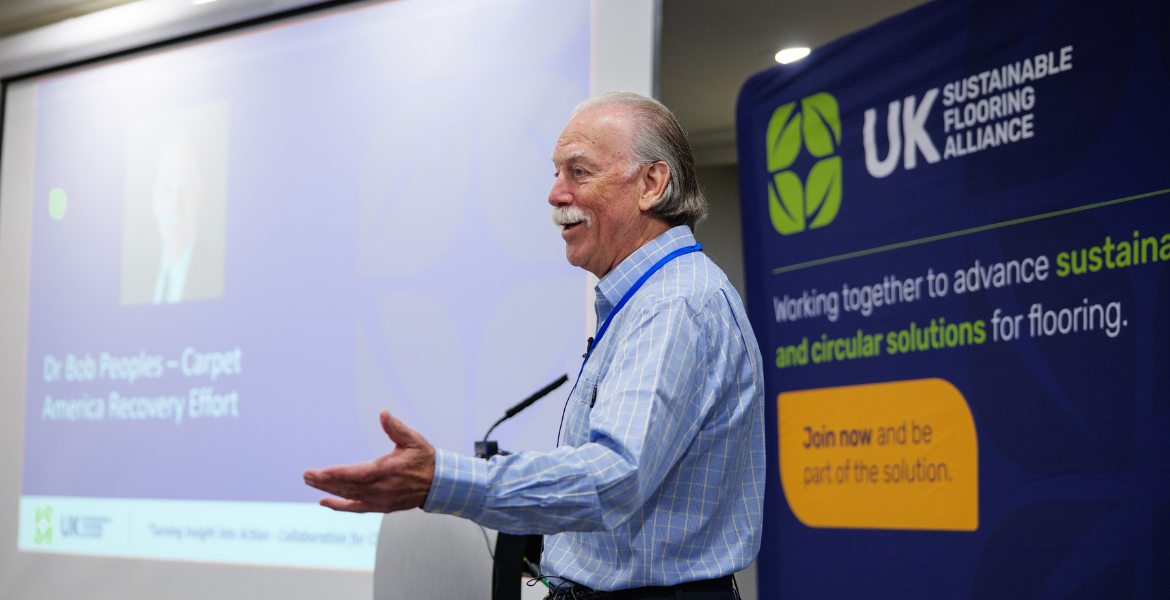
Richard Catt, CFA CEO and non-executive director of the UK Sustainable Flooring Alliance, talks to Dr Robert (Bob) Peoples, executive director of the Carpet America Recovery Effort (CARE), about what a quarter-century of US carpet recycling can teach the UK.
Dr Robert (Bob) Peoples is CEO and executive director of the Carpet America Recovery Effort (CARE), where he has led the organisation’s growth into a $45 million operational enterprise focused on reuse and recycling solutions for post-consumer carpet across North America. He is internationally recognised for his work in carpet recycling, sustainability, green chemistry and Extended Producer Responsibility (EPR). With decades of experience spanning industry, science and policy, he has played a major role in developing internationally recognised sustainability standards and is regarded as one of the flooring industry’s leading voices on circular economy and resource recovery.
I first heard Bob Peoples speak at the UK Sustainable Flooring Alliance’s Annual Conference in Solihull this summer, where he gave a frank account of what a quarter-century running America’s carpet stewardship scheme has taught him. There was clearly more to unpack than a single conference slot allowed, so I asked if he’d talk it through properly for CFA’s Guide to Sustainability. What follows is that conversation, less a recap of the presentation than an attempt to work out what, if anything, of the American experience genuinely travels to the UK market.
Peoples runs the Carpet America Recovery Effort, the independent, non-profit organisation created in January 2002 under a Memorandum of Understanding between the US carpet industry, a group of US states and the federal Environmental Protection Agency, to agree recycling targets, publish annual progress reports, and provide independent oversight organisation for the whole scheme. As it approaches its 25th anniversary in January 2027, I wanted to know what that experience really looks like once you strip away the achievement narrative.
Peoples’ answer to almost every question circled back to the same idea: nothing in this work happens in isolation. ‘I always like to start at 50,000 feet,’ he told me, running through a list that would not look out of place on a risk register for the planet, including rising CO2, water scarcity, pollution, population growth, global instability, and, newest of all, the energy and water demands of AI data centres. ‘Nothing on that list would surprise anyone in this industry, but together they set the conditions everything else has to work within.’
It’s why he reaches for the metaphor of an onion when people ask him how the work is going: ‘Every time you think you’ve figured something out, you realise you’ve got five more layers to peel before you really understand what you’re dealing with.’ I asked whether that ever became discouraging; he didn’t think so, more a reason to keep the scale of the problem honestly in view. He pointed to the plastics numbers: global virgin plastic production topped 445 million metric tonnes in 2025, roughly 54kg for every person alive, projected to reach 590 million tonnes (83kg per person) by 2050, while global plastics recycling rates stay under 5%
‘We’re competing for investment against an oil-backed production base that dwarfs us, and that’s true whether you’re in California or the UK.’
If there was one theme Peoples kept returning to unprompted, it was education, or rather, the lack of it, on the regulatory side. He told me about a conversation he’d once had with a US legislator: ‘I said, I’ll give you $10 million right now, in cash. Go build a recycling plant with it. But understand: it’s going to take you two years before you’re even at the point where you might turn the switch on. And when you do, it’s not going to run the way you expect. You’ll be reconfiguring it, buying new equipment, for another six to twenty-four months after that.’
His frustration isn’t with lawmakers themselves so much as the process behind them. ‘It’s the staff that write the law, not really the legislator,’ he said, staff who are rarely given the time or technical grounding to grasp subjects like the difference between chemical and mechanical recycling, certification, or mass balance accounting before a bill has to be drafted. He illustrated it with a diagram he uses often: a line representing how fast human understanding can absorb new information, running alongside a much steeper line representing the pace of technological and regulatory change. ‘We’ve crossed those lines. Talk to anybody, anywhere, and they’ll tell you they’re overwhelmed, with too much information coming in too fast to keep up with.’
I asked what that means practically for a trade body like CFA. His answer was blunt: get in early, and stay in. ‘You’ve got to recommit to helping decision-makers understand, continuously, not just once. It saves time, money, frustration, delays and reputations. It’s what enables progress.’
We spent a good part of the conversation on California’s post-consumer content requirement, a legal minimum of 5% recycled carpet content in new carpet sold in the state from January 2028, with New York setting a higher 10% bar on a longer timeline, and California expected to eventually align with it. On paper it reads as a straightforward market-shaping mechanism. In practice, Peoples said, it’s one of the hardest things his industry has been asked to do. ‘It’s one thing to take a bottle, grind it up, and make another bottle, a relatively clean, homogeneous polymer stream. Carpet has three, four, five components, sometimes more, designed to survive millions of footsteps for years. Taking it apart again and getting the purity you need to remake a product, is a heavy lift.’ Geography doesn’t help, either: most US carpet manufacturing sits on the East Coast, while most of the collected material, thanks to California’s programme, sits on the West Coast. ‘You’ve got to think about the cost of just getting that material across the country before you can do anything useful with it.’
Alongside the content mandate, California and New York have introduced mandatory ‘back-stamping’, codes printed on the back of carpet identifying manufacturer, production date, face fibre and backing composition, to help recyclers sort material correctly. CARE and the Carpet and Rug Institute jointly built the protocol, and Peoples doesn’t pretend it’s finished business. ‘A lot of the people doing the sorting either struggle with English or don’t speak it as a first language, and they’ve got to memorise these codes and then find them on the back of the carpet,’ he said. Durability is an open question too, as nobody yet knows how legible a stamp remains after twenty years glued to a subfloor. The whole exercise nearly ran into a wall in 2024, when a task force investigating contamination complaints discovered that far more manufacturers than realised were using PET in carpet backing, something the industry had simply assumed wasn’t happening. ‘Almost everybody was doing it,’ Peoples said. ‘And we only found that out by accident.’ And it is important to recognise we have a huge legacy inventory of carpet in use today. That means the back stamped product will only begin to show up for recycling in the future, maybe 3–10 years from when back stamping begins. I asked whether that meant the UK should think twice before adopting similar labelling mandates. ‘Not think twice, pilot it first, with the people who’ll actually be using it, before you write it into law. And don’t assume you know what’s really in the product. Go and check.’
To view the full article, alongside the latest sustainability insights, visit the CFA Guide to Sustainability 2026–2027.




Floorscape aims to serve as a valuable resource for both
the contract flooring
industry and
associated parties including architects, designers, main
contractors, shopfitters, builders
and
clients and is fully supported by the Contract Flooring Association.