

Have a news story for Floorscape? Get in touch with us to submit editor@floorscape.org.uk
Have a news story for Floorscape? Get in touch with us to submit editor@floorscape.org.uk
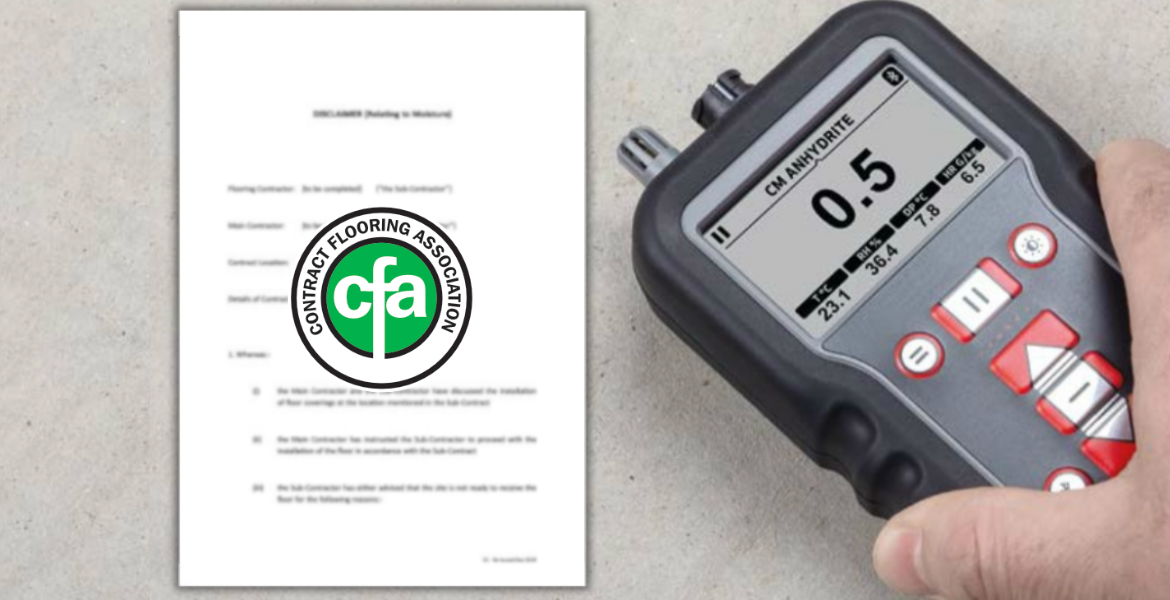
The CFA Moisture Disclaimer is available to CFA members as part of the collection of document templates, which together form a very useful member benefit.
Subfloor moisture remains the single most common cause of flooring failure in the UK. Whether it’s a new-build with a screed that hasn’t dried, a refurbishment over an old slab with no DPM, or a site where conditions have simply been left too late to investigate properly, the outcome is the same: adhesive breakdown, tile lift, sheet vinyl bubbling, timber cupping. The physical failure is bad enough. The legal and financial fallout can be much worse.
The relevant British Standards are BS 8203 for resilient coverings, BS 8201 for timber, and BS 5325 for textiles. Each sets out maximum recommended moisture levels for installation. When those levels are exceeded, the standards are clear: installation should not proceed until conditions are within recommended limits. However, construction programmes are rarely formed around waiting for concrete and screed to dry.
The real risk: proceeding without a paper trail
Here is the position contractors need to understand clearly. If flooring contracts install flooring knowing that moisture levels are above the recommended tolerances, and do so without formally recording that decision and obtaining agreement from the instructing party, they may be deemed to have accepted the suitability of the subfloor. In practical terms, that means the liability for any subsequent failure sits with them.
It doesn’t matter that the main contractor says to get on with it. It doesn’t matter that the site manager said the screed was fine. Without a written record that formally transfers the acknowledged risk, the contractor who physically carried out the installation is left holding the liability. That can mean covering the cost of uplift, disposal, re-preparation, new materials, and reinstallation, potentially running into tens of thousands of pounds on a commercial project.
What the CFA Moisture Disclaimer actually does
The CFA has as part of its suite of templates a Moisture Disclaimer template specifically for these situations. It isn’t a blunt refusal to work. It is a structured, signable document that does something very specific: it records the facts, identifies the risk, and obtains the main contractor’s informed agreement to proceed on clearly stated terms.
The disclaimer establishes that the flooring contractor has advised the site is not ready or has reason to believe that substrate moisture levels exceed the maximum recommended levels set out in the relevant British Standards. It records that in the contractor’s reasonable professional opinion, proceeding with installation is likely to result in failure. And it sets out the agreement that flows from that position: the floor is installed solely as a temporary installation; the flooring contractor will be paid as if the issue did not apply; and in the event of defects arising from the moisture condition, the flooring contractor shall not be liable.
That last point is critical. The disclaimer doesn’t just note the risk – it formally removes the flooring contractor’s liability for defects caused by the very condition they warned about. It shifts the decision, and the consequences of that decision, to the party who instructed the work to proceed.
If the main contractor signs and instructs you to proceed, make sure the signatory is authorised to bind the main contractor to that agreement. A site foreman’s signature may not carry the same weight as a contract or project manager’s. Make sure they have the necessary authority. And once you have that signed instruction, confirm it in writing, a brief letter or email acknowledging the instruction to proceed on the basis of the disclaimer is a must.
Professionalism, not confrontation
There is sometimes a reluctance among contractors to issue formal paperwork on site. The worry is that it creates friction, slows things down, or marks you out as difficult to work with. In reality, the opposite is true. Presenting a clear, professionally worded disclaimer demonstrates exactly the kind of competence and diligence that sets CFA members apart. You are not refusing to do the work. You are agreeing to do it but ensuring that the decision to proceed is made with full knowledge of the risks and on properly documented terms.
Any main contractor worth working with will respect that approach. And if they won’t sign it? That tells you something important about how they intend to handle things if the floor fails down the line.
A benefit worth using
The CFA Moisture Disclaimer is available to all CFA members and represents one of the most practically valuable resources the CFA provides. It costs nothing to use and could save a flooring contractor’s business from a claim that runs well beyond the value of the original contract.
Moisture problems on site are not going away. Programme pressures are not easing. But the way you manage the risk when those two realities collide is entirely within your control. Test the slab. Record the results. If conditions aren’t right, issue the disclaimer. Get it signed. Confirm it in writing. Then, and only then, proceed.
Don’t fit it and hope for the best. The mantra should be fit and forget.
A note on legal context
This article is intended to raise awareness of the CFA Moisture Disclaimer and to encourage its use as part of good professional practice. The commentary provided reflects the author’s experience as a flooring industry practitioner and is offered in good faith for general guidance only. It does not constitute legal advice, nor should it be relied upon as such. The Contract Flooring Association provides the Moisture Disclaimer template as a resource for its members, but neither the CFA nor the author accepts liability for the outcome of its use in any specific contractual situation. Contractors are strongly advised to seek independent legal advice where there is any uncertainty about their contractual position, and to ensure that any documentation used on a project is appropriate to the particular circumstances of that project.
CFA members can find the Moisture Disclaimer in their Members’ Area. If you are not a member already, find out more about the benefits and sign up today: www.cfa.org.uk/Join-the-Contract-Flooring-Association-Become-a-Member/



Floorscape aims to serve as a valuable resource for both
the contract flooring
industry and
associated parties including architects, designers, main
contractors, shopfitters, builders
and
clients and is fully supported by the Contract Flooring Association.