

Have a news story for Floorscape? Get in touch with us to submit editor@floorscape.org.uk
Have a news story for Floorscape? Get in touch with us to submit editor@floorscape.org.uk
The appearance and performance of floor coverings are determined to a large extent by the quality of the prepared base or screed on which they are laid. Those responsible for the design and construction of the subfloor must ensure that it meets the requirements for hardness, soundness, levels and surface regularities, dryness and other design parameters before flooring covering installation is commenced.
Any incompatibility with other trades or unsuitable conditions of work can restrict the ability of the floor layer to provide a neat, well adhered or installed, satisfactory and lasting floor finish. Clear contractual arrangements at the beginning and effective communications throughout the contract between all parties will minimise contention and maximise customer satisfaction.
This article explores some of the key requirements for sites preparing for a contract flooring job. With proper planning, projects can be completed with no surprises underfoot.
Before flooring coverings are laid it is necessary not only to ensure that the subfloor is constructed to prevent moisture reaching them from the ground but also to ensure that enough excess water within the subfloor, used in or during the construction process, is given time to evaporate – the time for this must be taken into account at the planning stage.
Estimated drying times are only very approximate, but research has shown that (under ideal conditions) screeds up to 50mm thick will take approximately 1 day per mm to dry under good drying conditions (a well-ventilated room) i.e. 20°C and <65% RH.
For screeds or concrete of greater thicknesses and particularly power floated finishes, this timescale increases significantly and can extend into many years.
Often project schedules do not allow for lengthy drying times and consideration needs to be given at the design stage to the use of surface DPMs.
Before the application of the floor finish a solid (cementitious or similar) base must be sufficiently dry to show a hygrometer reading not greater than 75% Relative Humidity when tested in accordance with the British Standard Code of Practice.
Equally, timber bases should be at equilibrium moisture content so that the state of dryness it attains in normal service conditions are in place at the time it is covered.
Floor screeds and all other in-situ floor bases need to have a surface regularity which complies with the requirements of BS 5325, BS 8203, BS 8204, BS 8201 and BS 8425 or other relevant Standards.
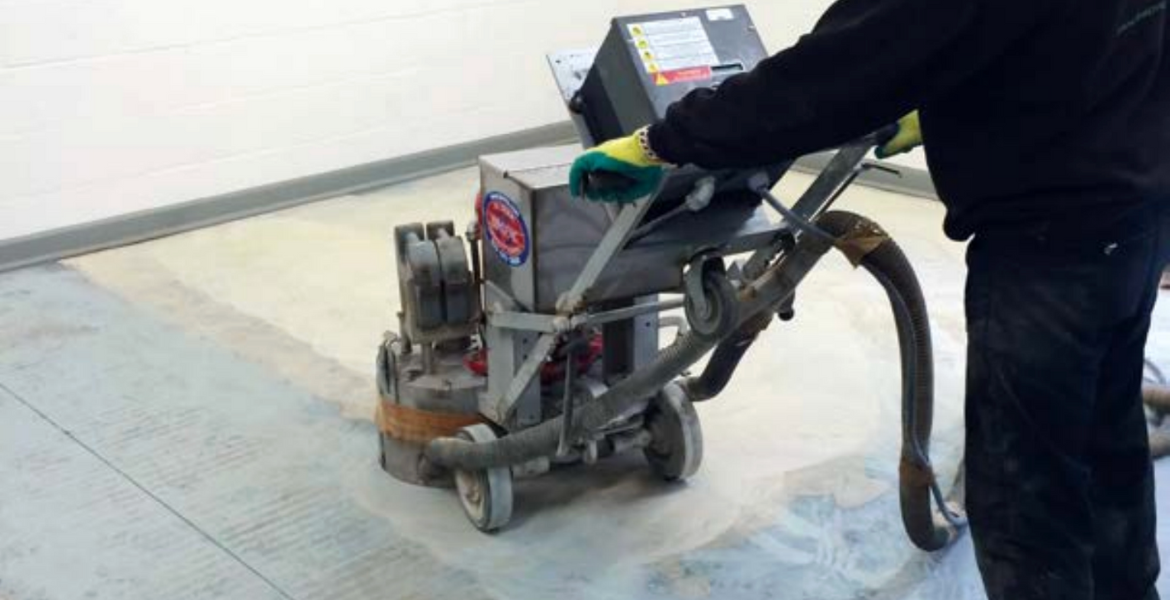
Directly finished concrete bases frequently do not comply with the required surface regularity or the smoothness needed to receive a floor finish. In addition, power floated finishes may provide a surface too dense to allow the flooring adhesive to dry and make a satisfactory bond. Mechanical surface preparatory work may often be required to create a suitable subfloor surface.
This will ensure that the finished floor covering adheres properly, realises its final properties and is durable enough to minimise the potential risk of failure.
Typical subfloor problems include uneven joints, high spots, contaminants, worn coatings, sticky residues, existing flooring, and friable substrates. Some new solid subfloors (such as concrete or anhydrite) may have a surface laitance which needs to be removed.
Methods such as shotblasting, scarifying, grinding and multi-stripping (see Section 4 of the CFA Guide to Contract Flooring) may need to be carried out to deliver a clean area with the required surface regularity suitable for the application of the new flooring material.
Those responsible for the design and construction of the subfloor may need to consider and specify preparatory work to the subfloor surface before instructing the flooring contractors to commence work.
Floor screeds and bases are not wearing surfaces and as soon as possible after laying should be protected against damage to the surface and contamination by other trades. Foot traffic from all trades can cause considerable surface abrasion and contamination. The effects on the flooring application are numerous, including:
Any areas of the screed surface damaged due to lack of protection or any other reason MUST be repaired before the flooring contractor commences work, although this cannot be accepted as an equal alternative to screed protection.
For more information about site requirements visit the CFA Guide to Contract Flooring.




Floorscape aims to serve as a valuable resource for both
the contract flooring
industry and
associated parties including architects, designers, main
contractors, shopfitters, builders
and
clients and is fully supported by the Contract Flooring Association.