

Have a news story for Floorscape? Get in touch with us to submit editor@floorscape.org.uk
Have a news story for Floorscape? Get in touch with us to submit editor@floorscape.org.uk
The Tile Association (TTA) is the UK trade association for the whole of the tiling industry – representing manufacturers, importers, distributors, retailers, tiling contractors and independent tile fixers. Its activity is based around three pillars which aim to 1) raise tiling standards, 2) improve the value of membership and 3) promote the benefits of tiles.
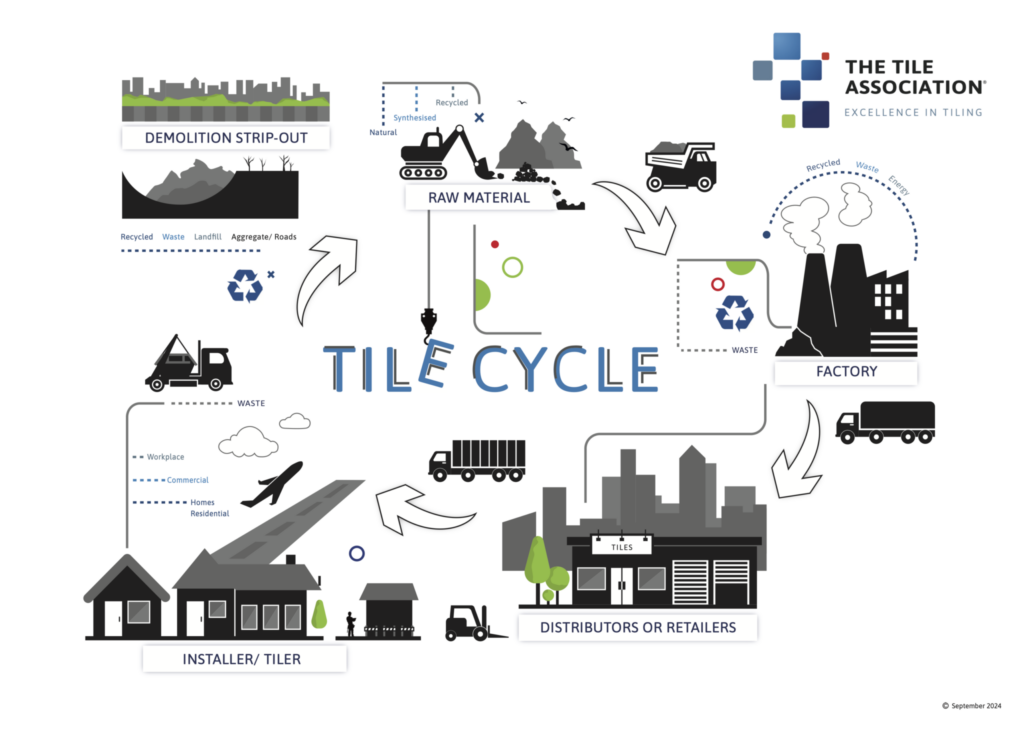
The built environment contributes 40% to the UK’s carbon emissions and therefore there is a big responsibility to reduce carbon throughout the construction industry. Though the tiling industry plays a small role in this larger picture, TTA nonetheless believes it is an important one and sees collaboration as the cornerstone to its sector’s success.
In 2022, TTA established a working group to develop a coordinated industry response to help member companies on their individual sustainability journeys and provide leadership for the tiling sector, chaired by TTA Board Director David Kong. This set out TTA’s vision to ‘take a leading role in achieving sustainability in the tiling sector, helping our members and the wider industry play its part in achieving Net Zero by 2050.’ The group includes tile distributors, retailers, importers, contractors, adhesive manufacturers and logistics providers.
TTA is keen to demonstrate the sustainability benefits of tiles and tiling companies and has provided digital resources for members to show their sustainability commitment, available on request. As a result, TTA allows members to set a positive example and declare how they are part of the collaborative network striving to make the tiling industry a more sustainable place. It has also identified 41 good reasons to choose tiles as they are durable, recyclable and have effective thermal mass properties as well as a reference service life of 60 years.
TTA’s Sustainability Working Group is available to answer TTA members’ sustainability questions, as businesses are increasingly required to understand and prepare for new rules, regulations and taxes. It also hosts a ‘Sustainability’ section on TTA’s website with key information on sustainability in the tiling sector as well as advice on ‘Ways to Be More Sustainable’ across key areas such as energy, manufacturing and transportation. This guidance is especially important given the typically high energy requirements for tile manufacturing and large amount of tile imports to the UK.
With regular meetings, TTA’s Sustainability Working Group continuously reviews how to take sustainability even further. To guide this effort, it reached out to members via a focused qualitative survey of independent tiler fixers and contractors and asked questions covering installation waste, product and material usage, office and warehouse energy use, packaging waste, transport & logistics and business miles and fuel. The results revealed that all contributors were aware of the key subjects but more progress was required for companies to measure and evaluate their carbon footprint, and by doing so, develop improvements. Nonetheless, all companies surveyed were keen to find ways to improve.
As an industry leading authority, TTA and its Sustainability Working Group continues to research and report on sustainability developments for the tiling sector. Updates can be found across Tile & Stone Journal (TSJ), Tilezine plus TTA’s website and social media.
For more information on the tiling sector’s sustainability progress, visit www.tiles.org.uk/sustainability/ or contact membership@tile.org.uk.
For more contract flooring sustainability advice, visit the CFA Guide to Sustainability 2025–2026.




Floorscape aims to serve as a valuable resource for both
the contract flooring
industry and
associated parties including architects, designers, main
contractors, shopfitters, builders
and
clients and is fully supported by the Contract Flooring Association.