

Have a news story for Floorscape? Get in touch with us to submit editor@floorscape.org.uk
Have a news story for Floorscape? Get in touch with us to submit editor@floorscape.org.uk
After the hygrometer box method and hygrometer sleeve method, some of the most commonly used floor moisture testing methods include the carbide bomb (CM) test, gravimetric oven test, and electrical impedance and RF devices. These methods are explored in the article below.
The CM test is a European Norm and is a national standard in many European states as the sign off. However, it is quite widely used in the UK by professional floor testers and is, in some cases, the preferred test recommended with certain types of floor screeds. In these circumstances the responsibility for testing the floor does not lie with the flooring contractor. Always consult the manufacturer’s specifications.
The CM test involves removing a sample of the slab/screed with a hammer and chisel and then crushing using a mortar and pestle. The required amount is then weighed and placed into an airtight chamber together with calcium carbide which, when in contact with moisture, produces acetylene gas.
The higher the concentration of moisture the more gas is produced, which is read as pressure from the devices gauge. Because calcium carbide reacts with free moisture only, the CM test will not measure chemically bound moisture within the sample. The test is ideal for certain fast-drying screeds, which act by chemically binding the majority of construction moisture and therefore cannot be tested with relative humidity or electrical impedance devices, which will give high results.
Here are some typical measurements which are specified/achieved with the CM test and at the same time specified in RH%:
Concrete/sand cement/pumpable cementitious slabs/screeds:
Anhydrite/hemi-hydrate screeds:
The main disadvantages of the test are the destructive nature and high potential for tester error.
This test involves removing a sample of the floor/screed carefully to ensure minimum loss of moisture, then, usually by sending to a lab, weighing the sample before and after drying in an oven to calculate the moisture content by weight (MC) which was present.
Gravimetric oven testing of concrete is usually performed at 105ºC which removes chemically bound as well as free moisture. Typical measurements which are specified/achieved with this type of test are:
Concrete/sand cement slabs/screeds:
Anyhdrite/hemi-hydrate screeds:
This test is seldom used and also has a high potential for error due to sample contamination.
NOTE: This testing method has no correlation to the above CM test with regards to cementitious materials due to the higher drying temperature typically used.
Many electrical impedance and RF (radio frequency) devices are available which provide instant, non destructive moisture readings from the surface of concrete floors and screeds, some providing relative (0-100) readings and some calibrated to give an indication of gravimetric oven or carbide method tests.
Such devices are useful indicators of high/low moisture levels and should be used as the best method to identify highest moisture concentrations, which should be the most suitable location for in-situ sleeve or humidity box tests.
Impedance and RF devices read from the surface and thus can give spurious readings in certain conditions. Care should be taken to identify that when ambient relative humidity conditions within the building are extremely high, condensation can form on the floor surface providing false positives. This should not occur when proper site conditions are maintained and monitored (as above).
Force drying with dehumidifiers can remove moisture from the surface first, providing artificially low readings, thus all drying aids should be shut down before for a minimum period of 48 hours before meaningful results should be taken.
The accuracy of impedance devices can be affected by the screed surface, therefore to improve accuracy these meters should only be used with flowing cementitious/calcium sulphate screeds when the surface has been fully sanded/abraded.
NOTE: Some surface reading moisture meters can read deep into the surface and therefore potentially pick up moisture within UFH systems. It is important to know the depth of reading of the device used.
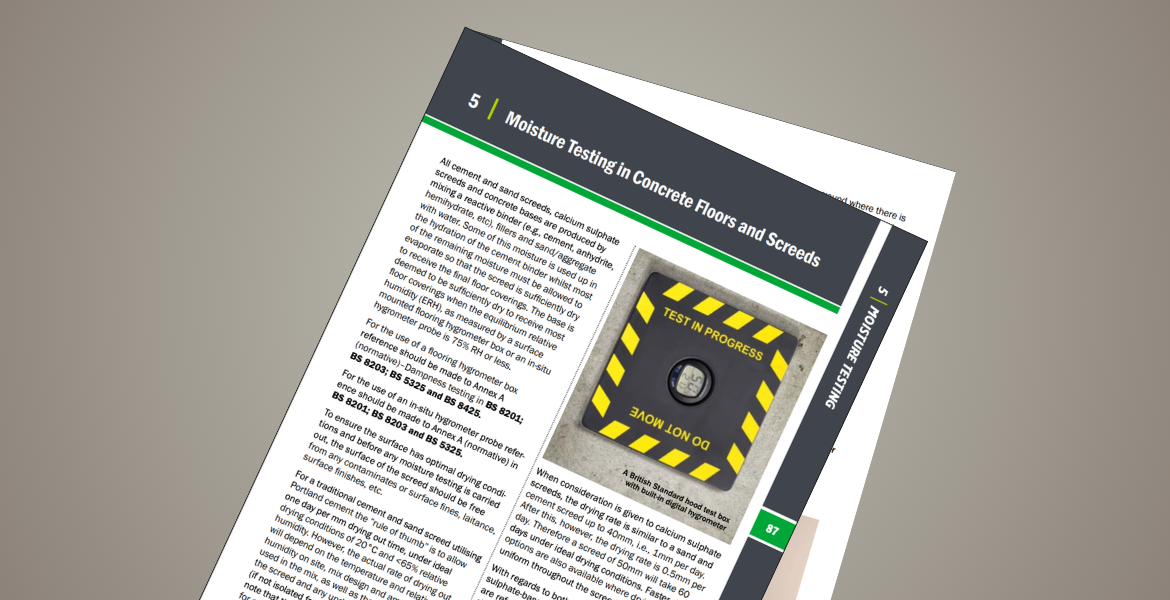
For more contract flooring technical advice, visit the CFA Guide to Contract Flooring.
For specific references to acceptable equilibrium relative humidity (ERH) limits and other key updated guidance, the CFA has recently published a member-only guidance note on moisture measurement for in-situ probe method, accessible in the General Guidance section of the CFA’s Member Area.



Floorscape aims to serve as a valuable resource for both
the contract flooring
industry and
associated parties including architects, designers, main
contractors, shopfitters, builders
and
clients and is fully supported by the Contract Flooring Association.