

Have a news story for Floorscape? Get in touch with us to submit editor@floorscape.org.uk
Have a news story for Floorscape? Get in touch with us to submit editor@floorscape.org.uk
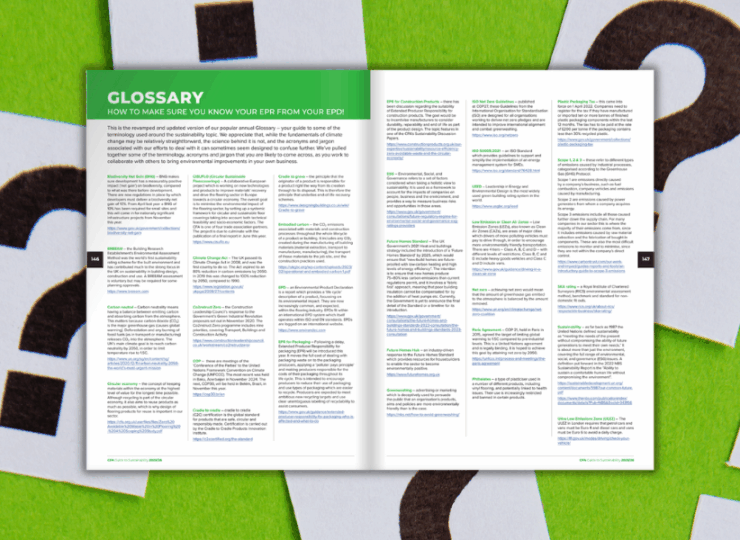
Understanding the terminology used in contract flooring is essential for achieving successful installations. From subfloor preparation and screeds to moisture conditions and smoothing compounds, the CFA Guide to Contract Flooring glossary explains some of the key technical terms commonly used across the flooring industry, providing a useful reference for flooring contractors, installers and specifiers.
Base Supporting structure to which the floor covering is to be applied.
Bonded screed Screed that is bonded to the base.
Chipboard See ‘Particleboard’.
Concrete base slab Concrete slab cast as part of the building construction.
ERH (Equilibrium Relative Humidity) Moisture migration from a material into the atmosphere and vice versa continues until stabilisation of the vapour pressures of water (inside the material and in the atmosphere inside a trapped pocket of air). When this equilibrium is reached, the moisture content of a material can be expressed in Equilibrium Relative Humidity (ERH).
Fabricated underlay Wood-based panel applied to a subfloor/base to provide a smooth, even surface suitable for the installation of a floor covering.
Ideal drying conditions A suitable level of temperature and RH% (i.e. <20°C & <65%RH) to promote drying of a material by vapour pressure, from a material with higher moisture to an atmosphere of lower moisture.
In-service moisture condition The moisture content which the material will hold when it has achieved equilibrium with its intended surroundings, i.e., hospitals and nursing homes will achieve lower RH% than a normal domestic environment.
Levelling screed Screed finished to obtain a defined level and to receive the final flooring.
Oriented Strand Board (OSB) Also known as sterling board, a wood-based panel sometimes used for subfloors in the UK similar to particleboard, formed by adding adhesives and then compressing layers of wood strands (flakes) in specific orientations.
Particleboard A wood-based panel that is commonly used for subfloors in the UK. Particleboard is made from particles of wood and formed under heat and pressure to cure the resin binder.
Power-floated concrete A power-floated concrete floor is one that is finished using a power trowel to level and harden the floor’s surface. Power floating is generally used for concrete surfaces that are expected to see heavy usage, such as warehouses. Power-floated concrete surfaces must be shot blasted or sanded prior to applying a bonded covering to achieve a ‘key’.
Screed Cement and sand/or calcium sulphate topping applied over concrete base slab and finished to receive the floor covering.
Smoothing compound See ‘Smoothing underlayment’.
Smoothing underlayment Smoothing and/or self-smoothing compound applied to subfloor to achieve a smooth, flat or level surface, suitable for the installation of the floor covering.
Subfloor See ‘Base’.
Unbonded screed Screed laid either onto a separating layer or onto a base not prepared to achieve bonding.
For more technical advice, visit the CFA Guide to Contract Flooring.



Floorscape aims to serve as a valuable resource for both
the contract flooring
industry and
associated parties including architects, designers, main
contractors, shopfitters, builders
and
clients and is fully supported by the Contract Flooring Association.