

Have a news story for Floorscape? Get in touch with us to submit editor@floorscape.org.uk
Have a news story for Floorscape? Get in touch with us to submit editor@floorscape.org.uk
Vinyl floor coverings are made up of a combination of PVC, fillers and plasticisers to enhance product performance characteristics and are an increasingly popular design option. They are attractive, cost effective and have excellent in-use performance and durability.
For commercial areas with high foot traffic, moisture exposure and strict hygiene requirements, vinyl flooring is fully flexible and available in sheet or tiles. They come in both fully adhered and loose lay sheet options, across homogenous construction (to BS EN ISO 10581) and heterogenous construction (to BS EN ISO 1582). This article explores different types now available on the market.
Used to describe vinyl tiles that simulate either natural or man-made products such as wood, natural stone, granite, ceramic and bespoke designer patterns/colours. Normally produced in heterogeneous construction, consisting of a backing layer, print film, reinforcement, and clear or coloured PVC wear layer for durability.
They can be of calendared (roll) or pressed (slab) sheet construction from which the tiles are cut to the finished size. The thickness of the wear layer determines the durability and type of use area. LVTs are available in a range of gauges with a wide choice of sizes, configurations (e.g. plank and tile), and qualities for both domestic and commercial situations.
Other options include LVTs with enhanced slip-resistance (to BS EN ISO 13845) and with approval for use in maritime environments.
This type of product generally comprises homogeneous or heterogeneous sheet vinyl flooring which is backed by a high-density PVC foam. The wear surface affords all the advantages of unbacked sheet vinyls to BS EN 10581 and BS EN 10582 in application, use and appearance. The inclusion of a foam backing affords excellent resilience, quietness and increased acoustic performance in terms of insulation against impact sound.
Application is normally carried out using adhesives of either the synthetic rubber or acrylic emulsion types. Seam joints in sheet must be welded to provide a jointless, watertight finish.
This type of flooring was designed to provide a highly resilient and hard-wearing floor to suit increased need for impact sound reduction in multi-use residential, hospitals, shops and office buildings to meet the requirements of building regulations. Impact sound reduction performance for these products is typically within the 14dB to 19dB range.
These may be of either homogeneous or heterogeneous construction. Classification is based on their enhanced sustainable slip-resistance performance in wet or contaminated conditions. The level and type of contamination must be considered when selecting slip-resistant floor coverings and emphasis placed on the requirement for correct maintenance to retain slip-resistance.
PVC floor coverings with particle-enhanced slip resistance (safety flooring) must comply with BS EN 13845. Enhanced slip resistance for these products is achieved through the addition of particles within the wear layer of the product. These particles ensure that the slip-resistant properties of the floor covering will be retained for the useful life of the product.
Products which provide slip-resistance through surface coatings, surface embossing or a combination of these are also available but at present there is no British or European Standard to which these products must conform with regard to their slip resistance.
For further information on the classification, selection and application of slip-resistant floor coverings, see section 14 of the CFA Guide to Contract Flooring.
These types of floor covering are used to control, within specified limits, Electrostatic Discharges (ESD) in usage areas where even very low levels of static charge may cause electronic component or systems failure, fire or explosions.
Available in fully bonded sheet and tile and loose-lay click systems, there is now a wide choice of designs/colours to suit all types of environment.
These floor coverings should not be confused with floor coverings offering anti-static properties only and which are primarily used to provide personal comfort to the individual by offering protection against shocks from static electricity.
Static control floor coverings will either be classified as Static Dissipative or Electrostatic Conductive. The electrical performance of ESD floors is covered by various European and international standards. The selection and performance requirements of ESD floor coverings is normally application-specific, so it is imperative that the products offered meets the end user’s application performance requirements.
See section 16 of the CFA Guide to Contract Flooring for further information on static control.
Cushioned vinyl floorings are available in a varied range of products and qualities for both domestic and commercial situations.
Domestic cushioned vinyls are excellent for the home because of their resilience and ease of maintenance. The integral foam backing provides comfort and warmth underfoot.
Some cushion vinyls can be loose laid by perimeter fixing within defined maximum size areas. For larger areas, fully adhering the material is recommended to give a more robust installation. Manufacturers will offer guidance on the maximum room size that can be installed using perimeter fixing.
Cushioned vinyl floorings with commercial-use classifications are suitable for private housing, flats and light contract areas. It is important to select the appropriate quality for each individual area in order to achieve the desired performance and life expectancy.
Other vinyl floor coverings offering cushioning properties such as products with a fibre or polyester backing to BS EN 650, or with a cork-based backing to BS EN 652 are also available. Cork-backed vinyls offer firmer resistance to traffic but are not so sound absorbing.
NOTE: when used over underfloor heeating, the higher thermal resistance of foam-backed products may reduce the efficiency.
Special grades of foam-backed vinyl floor coverings are available for sports hall installations. Whilst offering acoustic performance, the construction of these products is designed to meet the performance requirements of BS EN 14904 for indoor surfaces for multi-sport use.
Loose lay resilient vinyl tiles are suitable for laying in conjunction with other floor coverings such as carpet tiles. They are ideal for areas where access may be a necessity or where permanent bond adhesives cannot be used, e.g. to enable the reuse of an existing flooring in the future. These tiles are generally thicker construction than standard vinyl tiles and available in different configurations (plank and tile). They are typically of heterogeneous construction with a pure vinyl wear layer and either a filled PVC or closed cell foam backing, with reinforcement layers included for product stability.
Subfloor and installation requirements will vary by product type so the manufacturer should be consulted on suitability and installation guidance. Some subfloor types will require significantly less preparation than with standard products, others will require the same level as that of standard resilient finishes.
These tiles are usually adhered with a tackifier adhesive for ease of removal when used over raised access flooring (RAF). It is essential to check with the manufacturer what tolerances in terms of level and gaps the RAF must present before the floor finish can be installed, as imperfections can show through in exactly the same way as with most resilient floor coverings.
NOTE: Some loose lay tiles are constructed to be suitable for installation at higher levels of moisture than that prescribed in BS 8203. Consult product manufacturer for further advice.
LVT is now available in thicker formats with the edges profiled to click together much as a laminate flooring. These layers can be made simply of LVT (EN ISO 10582) or the surface can comprise any resilient product with an engineered rigid core of a solid PVC or mineral or any other suitable material.
They may also require separate underlay, have integral cushion backing or be fitted without underlay as per the manufacturer’s recommendations.
The planks lock together to form a large floating floor, therefore correct expansion gaps should be left at perimeters and around all fixed items to allow movement, especially in areas of temperature change. In areas of high traffic sometimes full bonding is recommended to avoid excessive movements and resulting faults.
Subfloor and installation requirements are sometimes minimal, but do not assume this to be the case as levels of preparation can often be similar to that of standard LVT product. This is to avoid movement that can create noise underfoot and plank connection damage. Consult the individual product literature along with the subfloor types to determine the preparation needed.
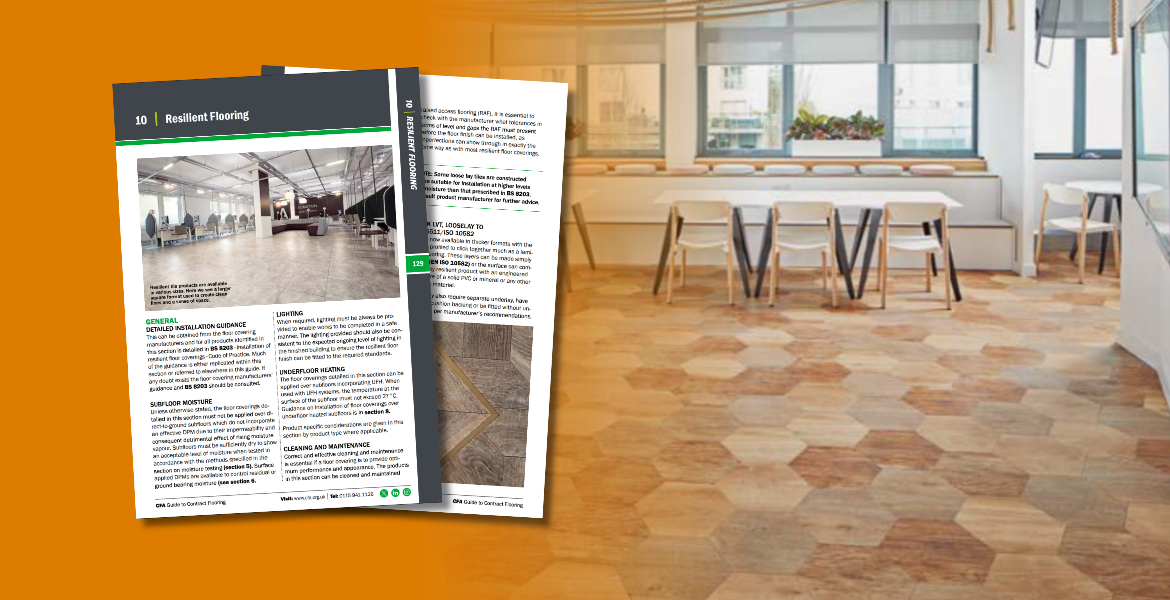
Explore further technical advice in the CFA Guide to Contract Flooring.
Find a manufacturer, distributor or contractor for your next vinyl flooring project using the CFA directory: cfa.org.uk/CFA-Flooring-Directory-find-Contractors-Consultants-Flooring-Manufacturers-and-Distributors/


Floorscape aims to serve as a valuable resource for both
the contract flooring
industry and
associated parties including architects, designers, main
contractors, shopfitters, builders
and
clients and is fully supported by the Contract Flooring Association.