

Have a news story for Floorscape? Get in touch with us to submit editor@floorscape.org.uk
Have a news story for Floorscape? Get in touch with us to submit editor@floorscape.org.uk
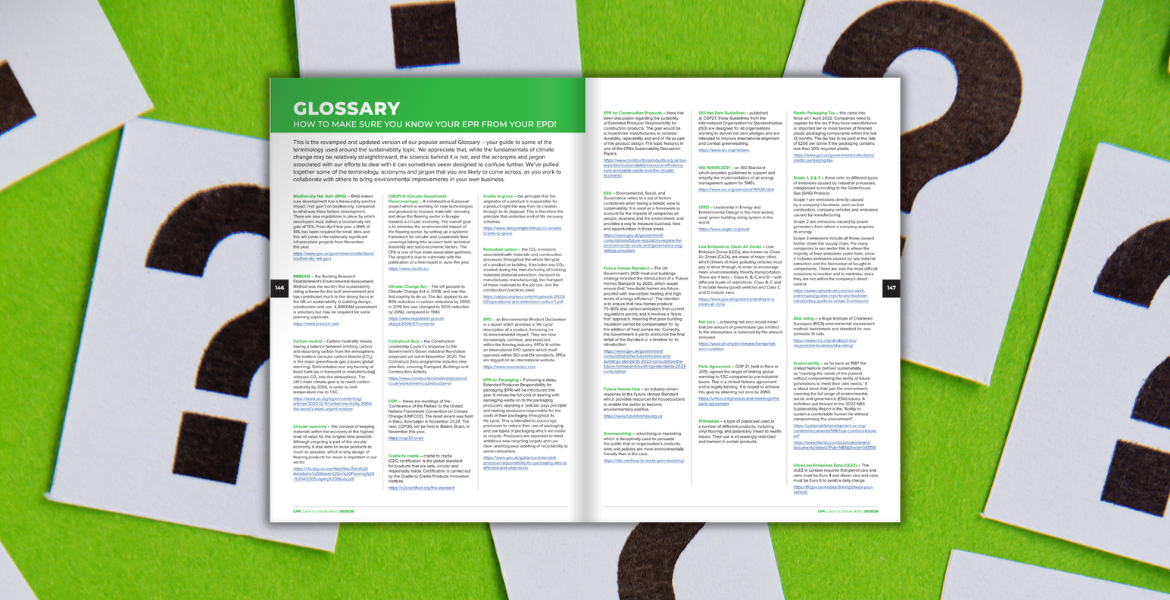
This is the latest version of the CFA Guide to Sustainability’s glossary – your guide to some of the terminology used around the sustainability topic. While the fundamentals of climate change may be relatively straightforward, the science behind it is not, and the acronyms and jargon associated with our efforts to deal with it can sometimes seem designed to confuse further. The guide pulls together some of the terminology, acronyms and jargon that you are likely to come across, as you work to collaborate with others to bring environmental improvements in your own business.
Biodiversity Net Gain (BNG) – BNG makes sure development has a measurably positive impact (‘net gain’) on biodiversity, compared to what was there before development. There are now regulations in place by which developers must deliver a biodiversity net gain of 10%. Since April 2024 a BNG of 10% has been required for small sites which also came in for nationally significant infrastructure projects from November 2025.
https://www.gov.uk/government/collections/biodiversity-net-gain
BREEAM – the Building Research Establishment’s Environmental Assessment Method was the world’s first sustainability rating scheme for the built environment and has contributed much to the strong focus in the UK on sustainability in building design, construction and use. A BREEAM assessment is voluntary but may be required for some planning approvals.
Carbon neutral – Carbon neutrality means having a balance between emitting carbon and absorbing carbon from the atmosphere. This matters because carbon dioxide (CO₂) is the major greenhouse gas (causes global warming). Deforestation and any burning of fossil fuels (as in transport or manufacturing) releases CO₂ into the atmosphere. The UN’s main climate goal is to reach carbon neutrality by 2050, in order to limit temperature rise to 1.5C.
Circular economy – the concept of keeping materials within the economy at the highest level of value for the longest time possible. Although recycling is part of the circular economy, it also aims to reuse products as much as possible, which is why design of flooring products for reuse is important in our sector.
CISUFLO (Circular Sustainable Floorcoverings) – A collaborative European project which is working on new technologies and products to improve materials’ recovery and drive the flooring sector in Europe towards a circular economy. The overall goal is to minimise the environmental impact of the flooring sector, by setting up a systemic framework for circular and sustainable floor coverings taking into account both technical feasibility and socio-economic factors. The CFA is one of four trade association partners. The project is due to culminate with the publication of a final report in June this year.
Climate Change Act – The UK passed its Climate Change Act in 2008, and was the first country to do so. The Act aspired to an 80% reduction in carbon emissions by 2050. In 2019 this was changed to 100% reduction by 2050, compared to 1990.
www.legislation.gov.uk/ukpga/2008/27/contents
Co2nstruct Zero – the Construction Leadership Council’s response to the government’s Green Industrial Revolution proposals set out in November 2020. The Co2nstruct Zero programme includes nine priorities, covering Transport, Buildings and Construction Activity.
www.constructionleadershipcouncil.co.uk/workstream/co2nstructzero/
COP – these are meetings of the ‘Conference of the Parties’ to the United Nations Framework Convention on Climate Change (UNFCCC). The most recent, COP30, was held in Belém, Brazil, in November 2025.
Cradle to cradle – cradle to cradle (C2C) certification is the global standard for products that are safe, circular and responsibly made. Certification is carried out by the Cradle to Cradle Products Innovation Institute.
https://c2ccertified.org/the-standard
Cradle to grave – the principle that the originator of a product is responsible for a product right the way from its creation through to its disposal. This is therefore the principle that underlies end-of-life recovery schemes.
www.designingbuildings.co.uk/wiki/Cradle-to-grave
Embodied carbon – the CO₂ emissions associated with materials and construction processes throughout the whole lifecycle of a product or building. It includes any CO₂ created during the manufacturing of building materials (material extraction, transport to manufacturer, manufacturing), the transport of those materials to the job site, and the construction practices used.
www.carboncure.com/concrete-corner/what-is-embodied-carbon/
EPD – an Environmental Product Declaration is a report which provides a ‘life cycle’ description of a product, focussing on its environmental impact. They are now increasingly common, and expected, within the flooring industry. EPDs fit within an international EPD system which itself operates within ISO and EN standards. EPDs are logged on an international website.
EPR for Packaging – Following a delay, full financial obligations for Extended Producer Responsibility for packaging (EPR) were introduced in 2025. The policy moves the full cost of dealing with packaging waste on to the packaging producers, applying a ‘polluter pays principle’ and making producers responsible for the costs of their packaging throughout its life cycle. This is intended to encourage producers to reduce their use of packaging and use types of packaging which are easier to recycle. Producers are expected to meet ambitious new recycling targets and use clear unambiguous labelling of recyclability to assist consumers.
EPR for Construction Products – there has been discussion regarding the suitability of Extended Producer Responsibility for construction products. The goal would be to incentivise manufacturers to consider durability, repairability and end of life as part of the product design. The topic features in one of the CPA’s Sustainability Discussion Papers.
ESG – Environmental, Social, and Governance refers to a set of factors considered when taking a holistic view to sustainability. It is used as a framework to account for the impacts of companies on people, business and the environment, and provides a way to measure business risks and opportunities in those areas.
https://commercial.allianz.com/news-and-insights/expert-risk-articles/esg-construction-industry.html
Future Homes Standard – The UK government’s 2021 Heat and buildings strategy included the introduction of a ‘Future Homes Standard’ by 2025, which would ensure that ‘new-build homes are future-proofed with low-carbon heating and high levels of energy efficiency’. The intention is to ensure that new homes produce 75–80% less carbon emissions than current regulations permit, and it involves a ‘fabric first’ approach, meaning that poor building insulation cannot be compensated for by the addition of heat pumps etc. Legislation is due to come into effect from December 2026.
Future Homes Hub – an industry-driven response to the Future Homes Standard which provides resources for housebuilders to enable the sector to become environmentally positive.
https://www.futurehomes.org.uk
Greenwashing – advertising or marketing which is deceptively used to persuade the public that an organisation’s products, aims and policies are more environmentally friendly than is the case.
https://nbs.net/how-to-avoid-greenwashing
ISO Net Zero Guidelines – published at COP27, these Guidelines from the International Organisation for Standardisation (ISO) are designed for all organisations working to deliver net zero pledges and are intended to improve international alignment and combat greenwashing.
ISO 50005:2021 – an ISO Standard which provides guidelines to support and simplify the implementation of an energy management system for SMEs.
https://www.iso.org/standard/76428.html
LEED – Leadership in Energy and Environmental Design is the most widely used green building rating system in the world.
Low Emission or Clean Air Zones – Low Emission Zones (LEZs), also known as Clean Air Zones (CAZs), are areas of major cities which drivers of more polluting vehicles must pay to drive through, in order to encourage more environmentally friendly transportation. There are 4 tiers – Class A, B, C and D – with different levels of restrictions. Class B, C and D include heavy goods vehicles and Class C and D include vans.
https://www.gov.uk/guidance/driving-in-a-clean-air-zone
Net zero – achieving net zero would mean that the amount of greenhouse gas emitted to the atmosphere is balanced by the amount removed.
www.un.org/en/climatechange/net-zero-coalition
Paris Agreement – COP 21, held in Paris in 2015, agreed the target of limiting global warming to 1.5C compared to pre-industrial levels. This is a United Nations agreement and is legally binding. It is hoped to achieve this goal by attaining net zero by 2050.
https://unfccc.int/process-and-meetings/the-paris-agreement/the-paris-agreement
Phthalates – a type of plasticiser used in a number of different products, including vinyl flooring, and potentially linked to health issues. Their use is increasingly restricted and banned in certain products.
For more sustainability advice, visit the CFA Guide to Sustainability 2025–2026.

Floorscape aims to serve as a valuable resource for both
the contract flooring
industry and
associated parties including architects, designers, main
contractors, shopfitters, builders
and
clients and is fully supported by the Contract Flooring Association.