

Have a news story for Floorscape? Get in touch with us to submit editor@floorscape.org.uk
Have a news story for Floorscape? Get in touch with us to submit editor@floorscape.org.uk
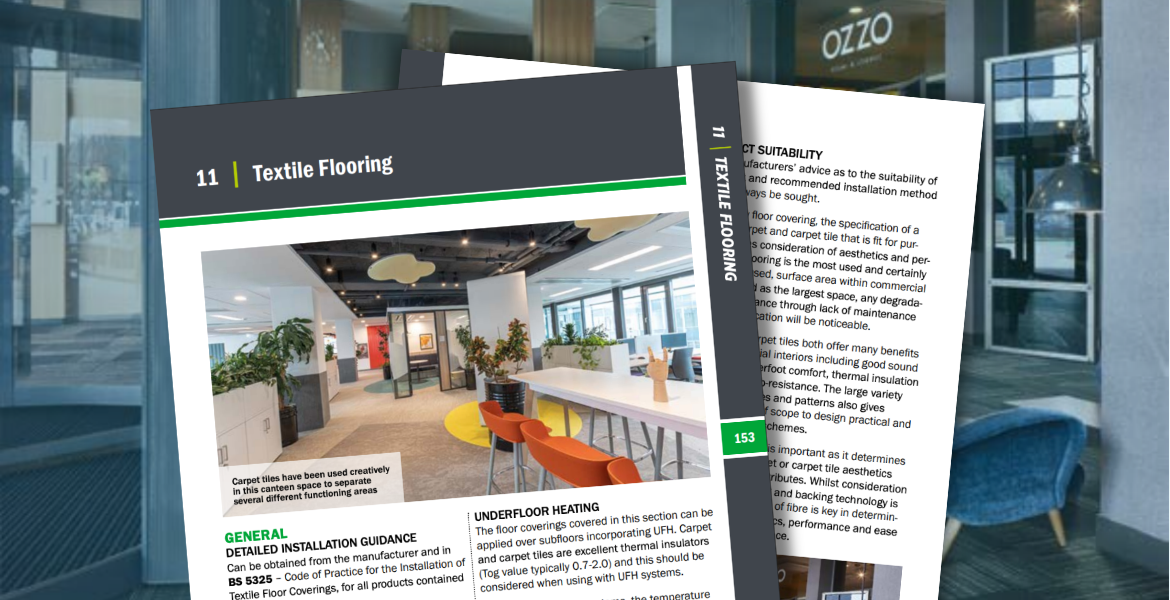
Carpet fibre choice is important as it determines the core of the carpet or carpet tile aesthetics and performance attributes. Whilst consideration of the manufacturing and backing technology is important, the choice of fibre is key in determining long-term aesthetics, performance and ease of care and maintenance.
This article is designed to highlight different types of carpet fibres to provide an insight into how fibre choice impacts the suitability of carpet flooring. Detailed installation guidance can be obtained from BS 5325 – Code of Practice for the Installation of Textile Floor Coverings, and the manufacturers’ BS 5325 – Code of Practice for the Installation of Textile Floor Coverings, for all products contained within this section.
Wool is a natural fibre shorn from sheep. The type is determined by the breed of the sheep and the climate. Most fabrics use long and short fibres or wool fibres that are interlocked together. Wool carpet has the natural ability to hold and release water vapour by climate conditions, thus acting as a natural humidifier. A microscopic view of the wool fibre shows overlapping scales arranged much like roof shingles. The scaly character of the fibre scatters optical light, thereby reducing soiling visibility. Wool is naturally flame resistant, forming a char that will neither melt nor drip.
Nylon carpet fibres take two forms: Nylon 6 and Nylon 6.6.
Chemically speaking, Nylon 6 is 1 monomer with 6 carbon atoms. Nylon 6.6 is made from 2 monomers with 6 carbon atoms each, which results in the designation of 6.6.
Nylon 6 resists fatigue and is very wear-resistant over time. It is often added to wool to create a wool-rich carpet with increased wear-resistance, particularly in lower pile weights and densities.
Nylon 6.6 has some extra benefits: its molecular structure provides an extremely hard-wearing fibre that also has a higher melting temperature and abrasion resistance.
Polypropylene is a widely used fibre in carpet manufacturing, either as part of a blend or as a single fibre type. Polypropylene is non-absorbent and dyed in the manufacturing process, so the colours are permanent. Polypropylene fibres are considered very strong and very abrasion resistant, though they are less resilient than some other fibres so may show increased pile flattening in heavy wear areas.
Other fibres used in the carpet and carpet tile market are acrylic and polyester. Polyester is becoming more popular in tile. These are lower cost fibres often used to ‘fill out’ the surface fibre.
It is common practice to blend fibres to arrive at the most acceptable mix in terms of quality and cost for the finished product. The best-known example is the 80%/20% blend of wool and polyamide, where the latter enhances durability and antistatic properties without noticeably diluting the benefits of wool mentioned above.
This is particularly relevant in the hospitality and leisure market where products are exposed to a wide variation of adverse wear and use conditions.
For more advice about textile flooring, visit the CFA Guide to Contract Flooring.


Floorscape aims to serve as a valuable resource for both
the contract flooring
industry and
associated parties including architects, designers, main
contractors, shopfitters, builders
and
clients and is fully supported by the Contract Flooring Association.